MCQ
An electronic transition from $1s$  orbital of an atom causes
  • Absorption of energy
  • B
    Release of energy
  • C
    Both release or absorption of energy
  • D
    Unpredictable

Answer

Correct option: A.
Absorption of energy
a
$1s$ orbital is the very ground state for an atom hence there always be absorption of energy if an electron transition takes place.

Need a full question paper?

Generate a complete, print-ready paper with questions like this in minutes — across 16+ boards, with answer keys.

Start Generating Free

Similar questions

Bohr's model can explain
Sulphur has highest oxidation state in
In order to prepare a buffer solution of $pH\, 5.74$ sodium acetate is added to acetic acid. If the concentration of acetic acid in the buffer is $1.0$ $M$, the concentration of sodium acetate in the buffer is ......... $M$. (Round off to the Nearest Integer).

[Given : $pKa$ (acetic acid) $=4.74$ ]

Consider the reaction $N _{2} O _{4}( g ) \rightleftharpoons 2 NO _{2}( g )$

The temperature at which $K _{ C }=20.4$ and $K _{ P }=600.1,$ is ....... $K$. (Round off to the Nearest Integer).

[Assume all gases are ideal and $R =0.0831\, L\,bar \, K ^{-1} mol ^{-1}]$

Addition of bromine to $1, 3-$butadiene gives
The $IUPAC$ name of $\begin{array}{*{20}{c}}
  {CH - C - O - C{H_2} - C - OH} \\ 
  {||\,\,\,\,\,\,\,\,\,\,\,\,\,\,\,\,\,\,\,\,\,\,\,\,\,\,\,\,\,\,\,||} \\ 
  {O\,\,\,\,\,\,\,\,\,\,\,\,\,\,\,\,\,\,\,\,\,\,\,\,\,\,\,\,\,O} 
\end{array}$ is :
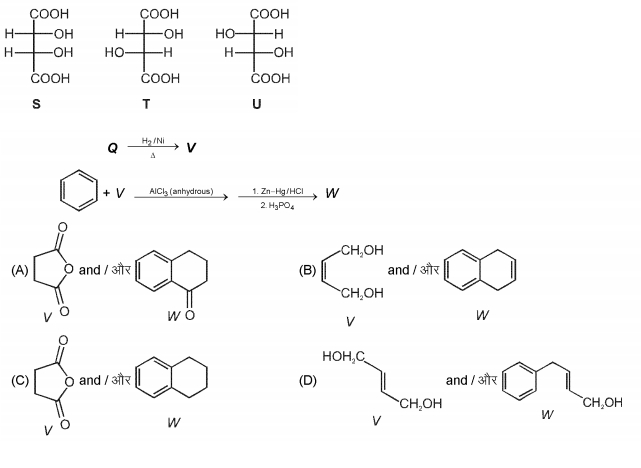
$P$ and $Q$ are isomers of dicarboxylic acid $C _4 H _4 O _4$. Both decolorize $Br _2 / H _2 O$. On heating, $P$ forms the cyclic anhydride.

Upon treatment with dilute alkaline $KMnO _4, P$ as well as $Q$ could produce one or more than one from $S , T$ and $U$.$Image$

$1.$ Compounds formed form $P$ and $Q$ are, respectively

$(A)$ Optically active $S$ and optically active pair $(T, U)$

$(B)$ Optically inactive $S$ and optically inactive pair $(T, U)$

$(C)$ Optically active pair $(T, U)$ and optically active $S$

$(D)$ Optically inactive pair $(T, U)$ and optically inactive $S$

$2.$ In the following reaction sequences $V$ and $W$ are respectively :$Image$

mcq $Image$

Give the answer question $1$ and $2.$
Silver reacts with hydro chloric acid to give ________:
Which of the following is the buffer solution of strong acidic nature
$2\,L$ of $0.2\,M H _{2} SO _{4}$ is reacted with $2\,L$ of $0.1\,M$ $NaOH$ solution, the molarity of the resulting product $Na _{2} SO _{4}$ in the solution is millimolar. (Nearest integer).