MCQ
An element $A$ decays into element $C$ by a two step process :
$\begin{aligned} & \mathrm{A} \rightarrow \mathrm{B}+2^{\mathrm{He}^4} \\ & \mathrm{~B} \rightarrow \mathrm{C}+2^{\mathrm{e}^{-}}\end{aligned}$
Then
  • $A$ and $C$ are isotopes
  • B
    $A$ and $C$ are isobars
  • C
    $A$ and $B$ are isotopes
  • D
    $A$ and $B$ are isobars

Answer

Correct option: A.
$A$ and $C$ are isotopes

Need a full question paper?

Generate a complete, print-ready paper with questions like this in minutes — across 16+ boards, with answer keys.

Start Generating Free

Similar questions

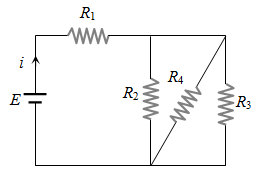
In the circuit given $E = 6.0 V, R_1 = 100\ ohms, R_2 = R_3 = 50\ ohms, R_4 = 75\ ohms$. The equivalent resistance of the circuit, in $ohms,$ is
A charged particle moves in a uniform magnetic field. The velocity of the particle at some instant makes an acute angle with the magnetic field. The path of the particle will be:
For watt$-$less power in an $AC$ circuit the phase angle between the current and voltage is.
A radio transmitter operates at a frequency of $880\ kHz$ and a power of $10\ kW.$ The number of photons emitted per second are
An electric lamp is marked 60 W, 230 V. The cost of a 1 kWh of energy is Rs. 1.25. The cost of using this lamp 8 hrs a day for 30 day is(a) Rs. 10 (b) Rs. 16(c) Rs. 18 (d) Rs. 20
       
If a 30 V, 90 W bulb is to be worked on a 120 V line, a resistance of how many ohms should be connected in series with the bulb (a) 10 ohm(b) 20 ohm(c) 30 ohm(d) 40 ohm
       
A nucleus of an element $84^{\mathrm{x}^{202}}$ emits an $\alpha-$particle first, a $\beta-$particle next and then a gamma photon. The final nucleus formed has an atomic number
A student says that he had applied a force $\text{F}=-\text{k}\sqrt{\text{x}}$ on a particle and the particle moved in simple harmonic motion. He refuses to tell whether k is a constant or not. Assume that he was worked only with positive x and no other force acted on the particle.
  1. As x increases k increases.
  2. As x increases k decreases.
  3. As x increases k remains constant.
  4. The motion cannot be simple harmonic.
If the external force acting on a system have zero resultant, the centre of mass:
  1. Must not move.
  2. Must not accelerate.
  3. May move.
  4. May accelerate.
Assertion :   A star which appears blue will be much hotter than the sun
Reason     : It is based on Wien's law(a) If both assertion and reason are true and the reason is the correct explanation of the assertion.(b) If both assertion and reason are true but reason is not the correct explanation of the assertion.(c) If assertion is true but reason is false.(d) If the assertion and reason both are false.