Question
An element is sonorous and highly ductile. Under which category would you classify this element? What other characteristics do you expect the element to possess?

Answer

As the given element is sonorous and highly ductile, therefore, it is categorised as a metal. Some other e pected characteristics of are:
  1. It should possesses metallic lustre and can be polished.
  2. It should be good conductors of heat and electricity.
  3. It should be ductile.
  4. It should be malleable.
  5. It should has high tensile strength.
  6. It should has high densities and melting point/boiling point too.
  7. It should be hard (except sodium and potassium which are soft metals).
  8. It should be solid at room temperature (except mercury, which is liquid at room temperature).
While the characteristics of non-metals are:
  1. Non-metals are neither malleable nor ductile and do not conduct electricity.
  2. Metalloids show some properties of metals and some other properties of non-metals.

Need a full question paper?

Generate a complete, print-ready paper with questions like this in minutes — across 16+ boards, with answer keys.
Start Generating Free

Similar questions

Give two examples each of longitudinal waves and transverse waves.
If the back of your hand is moistened with alcohol, you will find that it rapidly becomes dry. Why is it that while it is drying, your hand feels cool?
How can you obtain pure water from a salt-water mixture (or salt-solution)? Draw a meat and labelled diagram of the apparatus you would use to obtain pure water from a salt-water mixture (or salt-solution).
Write a note on cattle feed.
An automobile engine propels a $1000\ kg$ car
$(A)$ along a levelled road at a speed of $36\ km\ h^{-1}.$ Find the power if the opposing frictional force is $100N$.
Now, suppose after travelling a distance of $200m,$ this car collides with another stationary car
$(B)$ of same mass and comes to rest. Let its engine also stop at the same time. Now car $(B)$ starts moving on the same level road without getting its engine started. Find the speed of the car $(B)$ just after the collision.
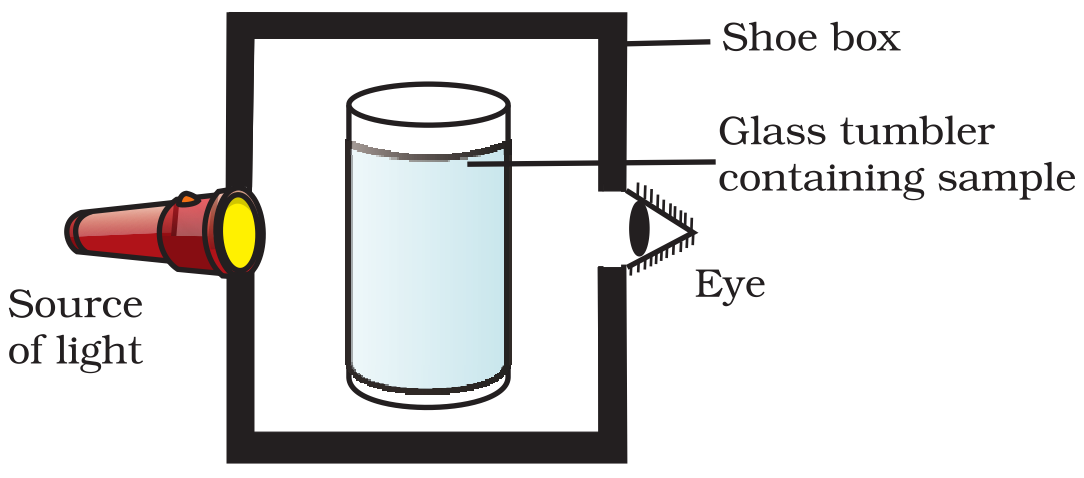
A group of students took an old shoe box and covered it with a black paper from all sides. They fixed a source of light $($a torch$)$ at one end of the box by making a hole in it and made another hole on the other side to view the light. They placed a milk sample contained in a beaker/ tumbler in the box as shown in the they were amazed to see that milk taken in the tumbler was illuminated. They tried the same activity by taking a salt solution but found that light simply passed through it?
  1. Explain why the milk sample was illuminated. Name the phenomenon involved.
  2. Same results were not observed with a salt solution. Explain.
  3. Can you suggest two more solutions which would show the same effect as shown by the milk solution?
Which separation techniques will you apply for the separation of the following?
  1. Sodium chloride from its solution in water.
  2. Ammonium chloride from a mixture containing sodium chloride and ammonium chloride.
  3. Small pieces of metal in the engine oil of a car.
  4. Different pigments from an extract of flower petals.
  5. Butter from curd.
  6. Oil from water.
  7. Tea leaves from tea.
  8. Iron pins from sand.
  9. Wheat grains from husk.
  10. Fine mud particles suspended in water.
A liquid compound X of molecular mass 18u can be obtained from a number of natural sources. All the animals and plants need liquid X for their survival. When an electric current is passed through 200 grams of pure liquid X under suitable conditions, then 178 grams of gas Y and 22 grams of gas Z are produced. Gas Y is produced at the positive electrode whereas gas Z is obtained at the negative electrode. Moreover, gas Y supports combustion whereas gas Z burns itself causing explosions.
  1. Name (i) liquid X (ii) gas Y, and (iii) gas Z
  2. What is the ratio to the mass of element Z to the mass of element Y in the liquid X?
  3. Which law of chemical combination is illustrated by this example?
  4. Name two sources of liquid X.
  5. Gate an important use of Y in our life.
Draw a flow sheet diagram showing the separation of various components of a mixture containing camphor, sand and iron filings.
Calculate the number of aluminium ions present in $0.051g$ of aluminium oxide. $($Hint: The mass of an ion is the same as that of an atom of the same element. Atomic mass of $Al = 27u)$