Question
An element ‘X’ (Atomic number = 20) burns in the presence of oxygen to form a basic oxide.
  1. Identify the element and write its electronic configuration.
  2. State its group number and period number in the Modern Periodic Table.
  3. Write a balanced chemical equation for the reaction when this oxide is dissolved in water.
Answer

We are given that the element is present in the $2^{\text {nd }}$ group and the $4^{\text {th }}$ period.
i. Therefore this element is Calcium. Its atomic number is 20 and its electronic configuration is 20 .
ii. Its electronic configuration is $2,8,8,2$.
iii. When calcium oxide is dissolved in water, calcium hydroxide is formed. Following is the equation,
$CaO+H_2 O \rightarrow Ca(OH)_2$

Need a full question paper?

Generate a complete, print-ready paper with questions like this in minutes — across 16+ boards, with answer keys.

Start Generating Free

Similar questions

Describe the working of the human eye with the help of the above diagram.
Describe the process of respiration in State whether it is anaerobic respiration or aerobic respiration.
Why could no fixed position be given to hydrogen in Mendeleev’s periodic table?
What is ‘‘dispersion of white light’’? Draw a labelled diagram to illustrate the recombination of the spectrum of white light. Why is it essential that the two prisms used for the purpose should be identical and placed in an inverted position with respect to each other?
Why is chemical communication better than electrical impulses as a means of communication between cells in a multi-cellular organism?
What is meant by ‘systolic pressure’ and ‘diastolic pressure’? What are their normal values?
  1. Explain the terms:
  1. Implantation.
  2. Placenta.
  1. What is the average duration of human pregnancy?
State the three common features of all the respiratory organs like skin, gills and lungs.
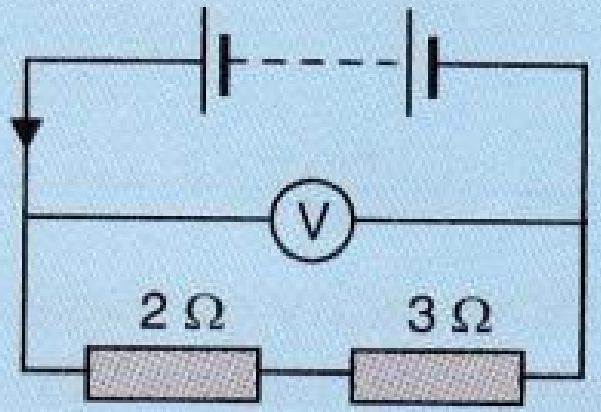
In the circuit shown below, the voltmeter reads 10V.
  1. What is the combined resistance?
  2. What current flows?
  3. What is the p.d. across $ 2 Ω$ resistor?
  4. What is the p.d. across $3 Ω$ resistor?
No chemical reaction takes place when granules of a solid, A, are mixed with the powder of another solid, B. However when the mixture is heated, a reaction takes place between its components. One of the products, C, is a metal and settles down in the molten state while the other product, D, floats over it. It was observed that the reaction is highly exothermic.
  1. Based on the given information make an assumption about A and B and write a chemical equation for the chemical reaction indicating the conditions of reaction, physical state of reactants and products and thermal status of the reaction.
  2. Mention any two types of reactions under which above chemical reaction can be classified.