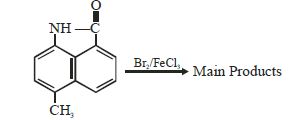
MCQ
An elementary particle is
- AAn element present in a compound
- BAn atom present in an element
- ✓A sub-atomic particle
- DA fragment of an atom
Generate a complete, print-ready paper with questions like this in minutes — across 16+ boards, with answer keys.
$CO + \frac{1}{2}{O_2} \to C{O_2};\,\Delta H = Y$
Then the heat of formation of $CO$ is
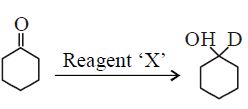
$\mathrm{Sn}(\mathrm{s})\left|\mathrm{Sn}^{2+}(\mathrm{aq}, 1 \mathrm{M}) \| \mathrm{Pb}^{2+}(\mathrm{aq}, 1 \mathrm{M})\right| \mathrm{Pb}(\mathrm{s})$
the ratio $\frac{\left[\mathrm{Sn}^{2+}\right]}{\left[\mathrm{Pb}^{2+}\right]}$ when this cell attains equilibrium is
(Given $\mathrm{E}_{\mathrm{Sn}^{2+} / \mathrm{Sn}}^{0}=-0.14 \mathrm{\;V}$ $\left.\mathrm{E}_{\mathrm{Pb}^{+2}/{\mathrm{Pb}}}^{0}=-0.13 \;\mathrm{V}, \frac{2.303 \mathrm{RT}}{\mathrm{F}}=0.06\right)$
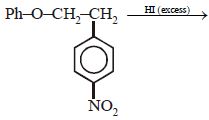
$CH_3CH_2Cl \xrightarrow{NaCN}(i)\xrightarrow{Ni/{{H}_{2}}}(ii)\xrightarrow{acetic\,anhydride}(iii)$ , Product $(iii)$ is