Question
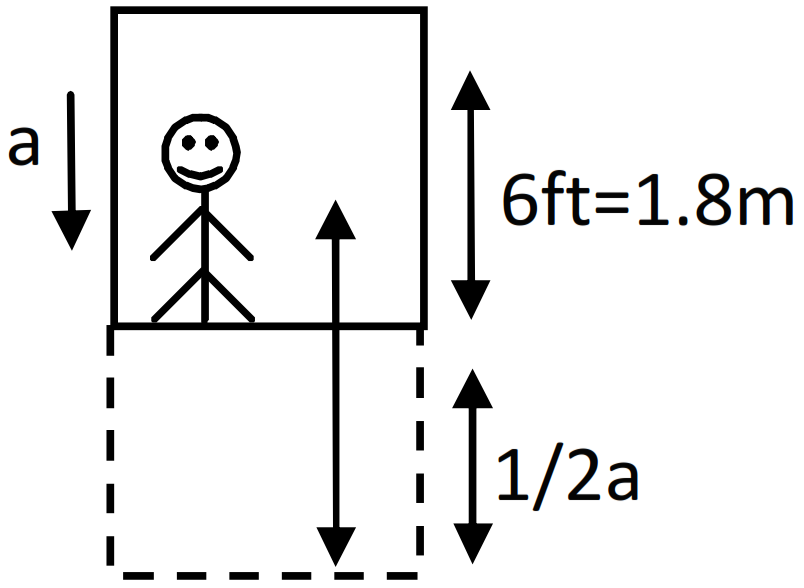
An elevator is descending with uniform acceleration. To measure the acceleration, a person in the elevator drops a coin at the moment the elevator starts. The coin is 6ft above the floor of the elevator at the time it is dropped. The person observes that the coin strikes the floor in 1 second. Calculate from these data the acceleration of the elevator.
Answer

For elevator and coin u = 0 As the elevator descends downward with acceleration a' (say) The coin has to move more distance than 1.8m to strike the floor. Time taken t = 1 sec.$\text{S}_{\text{c}}=\text{ut}+\frac{1}{2}\text{a}'\text{t}^2=0+\frac{1}{2}\text{g}(1)^2=\frac{1}{2}\text{g}$
$\text{S}_{\text{e}}=\text{ut}+\frac{1}{2}\text{at}^2=\text{u}+\frac{1}{2}\text{a}(1)^2=\frac{1}{2}\text{a}$
Total distance covered by coin is given by $=1.8+\frac{1}{2}\text{a}=\frac{1}{2}\text{g}$$\Rightarrow1.8+\frac{\text{a}}{2}=\frac{9.8}{2}=4.9$
$\Rightarrow\text{a}=6.2\text{m/s}^2=6.2\times3.28=20.34\text{ft/s}^2.$

Need a full question paper?

Generate a complete, print-ready paper with questions like this in minutes — across 16+ boards, with answer keys.

Start Generating Free

Similar questions

Ram is a student of class X in a village school. His uncle gifted him a bicycle with a dynamo fitted in it. He was very excited to get it. While cycling during night, he could light the bulb and see the objects on the road. He however, did not know this device works. He asked this question to his teacher. the teacher considered it an opportunity to explain the working to the whole class.
Answer the following question:
  1. State the principle and working of a dynamo.
  2. Write two values each displayed by Ram and his school teacher.
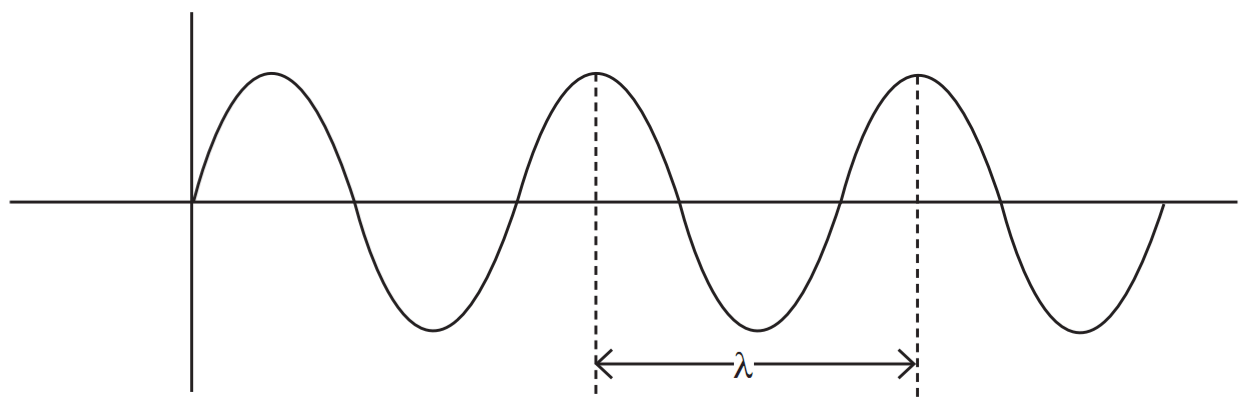
According to de-Broglie, a moving material particle sometimes acts as a wave and sometimes as a particle or a wave associated with moving material particle which controls the particle in every respect. The wave associated with moving particle is called matter wave or de-Broglie wave where wavelength called de-Broglie wavelength, rs given by $\lambda=\frac{\text{h}}{\text{mv}}$.
  1. If a proton and an electron have the same de Broglie wavelength, then:
  1. Kinetic energy of electron < kinetic energy of proton.
  2. Kinetic energy of electron = kinetic energy of proton.
  3. Momentum of electron = momentum of proton.
  4. momentum of electron < momentum of proton.
  1. Which of these particles having the same kinetic energy has the largest de Broglie wavelength?
  1. Electron
  2. Alpha particle
  3. Proton
  4. Neutron
  1. Two particles $A_1$ and $A_2$ of masses $m_1, m_2 (m_1 > m_2)$ have the same de Broglie wavelength. Then:
  1. Their momenta are the same.
  2. Their energies are the same.
  3. Momentum of $A_1$ is less than the momentum of $A_1$.
  4. Energy of $A_1$ is more than the energy of $A_2.$
  1. When the velocity of an electron increases, its de Broglie wavelength:
  1. Increases.
  2. Decreases.
  3. Remains same.
  4. May increase or decrease.
  1. Proton and $\alpha$ - particle have the same de-Broglie wavelength. What is same for both of them?
  1. Time period
  2. Energy
  3. Frequency
  4. Momentum
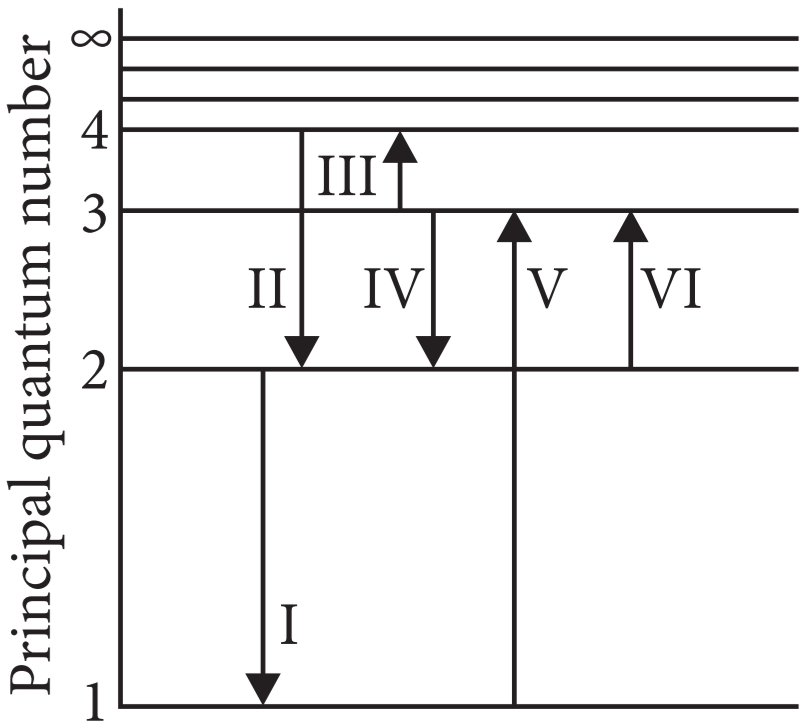
Bohr's model explains the spectral lines of hydrogen atomic emission spectrum. While the electron of the atom remains in the ground state, its energy is unchanged. When the atom absorbs one or more quanta of energy, the electrons moves from the ground state orbit to an excited state orbit that is further away.

The given figure shows an energy level diagram of the hydrogen atom. Several transitions are marked as I, II, III and so on. The diagram is only indicative and not to scale.
  1. In which transition is a Balmer series photon absorbed?
  1. II
  2. III
  3. IV
  4. VI
  1. The wavelength of the radiation involved in transition II is
  1. 291nm
  2. 364nm
  3. 487nm
  4. 652nm
  1. Which transition will occur when a hydrogen atom is irradiated with radiation of wavelength 103nm?
  1. I
  2. II
  3. IV
  4. V
  1. The electron in a hydrogen atom makes a transition from $n = n_1$ to $n = n_2$ state. The time period of the electron in the initial state is eight times that in the final state. The possible values of $n_1$ and $n_2$ are.
  1. $n_1 = 4,n_2 = 2$
  2. $n_1 = 8,n_2 = 2$
  3. $n_1 = 8,n_2 = 3$
  4. $n_1 = 6,n_2 = 2$
  1. The Balmer series for the H-atom can be observed
  1. If we measure the frequencies of light emitted when an excited atom falls to the ground state.
  2. If we measure the frequencies of light emitted due to transitions between excited states and the first excited state.
  3. In any transition in a H-atom.
  4. None of these.
To convert two atoms into ions, 2 electrons have been removed from each of them. When these ions are placed in a vacuum, they repel each other with a force of $3.7 \times 10^{-9}$ Newton. Find the distance between them.
An ideal gas is pumped into a rigid container having diathermic walls so that the temperature remains constant. In a certain time interval, the pressure in the container is doubled. Is the internal energy of the contents of the container also doubled in the interval?
To keep valuable instruments away from the earth's magnetic field, they are enclosed in iron boxes. Explain.
The charge enclosed by a spherical Gaussian surface is $8.85 \times 10^{-8}$ Coulomb. Calculate (a) the electric flux emerging out of the Gaussian surface, (b) what will be the change in electric flux if the radius of the Gaussian surface is doubled?
A capacitor is a device to store energy. The process of charging up a capacitor involves the transferring of electric charges from its one place to another. This work done in charging the capacitor is stored as its electrical potential energy.
If q is the charge and V is the potential difference across a capacitor at any instant during its charging, then small work done in storing an additional small charge dq against the repulsion of charge q already stored on it is $\text{dW}=\text{V.dq}=(\frac{\text{q}}{\text{C}})\text{dq}.$
  1. A system of 2 capacitors of capacitance $2\mu\text{F}$ and $4\mu\text{F}$ is connected in series across a potential difference of 6 V. The energy stored in the system is:
  1. $3\mu\text{J}$
  2. $24\mu\text{J}$
  3. $30\mu\text{J}$
  4. $108\mu\text{J}$
  1. A capacitor of capacitance of $10\mu\text{F}$ is charged to 10V. The energy stored in it is:
  1. $100\mu\text{J}$
  2. $500\mu\text{J}$
  3. $1000\mu\text{J}$
  4. $1\mu\text{J}$
  1. A parallel plate air capacitor has capacity C farad, potential V volt and energy E joule. When the gap between the plates is completely filled with dielectric:
  1. Both V and E increase.
  2. Both V and E decrease.
  3. V decreases, E increases.
  4. V increases, E decreases.
  1. A capacitor with capacitance $5\mu\text{F}$ s charged to $5\mu\text{C}.$ If the plates are pulled apart to reduce the capacitance to $2\mu\text{F},$ how much work is done?
  1. $6.25 \times 10^{-6}J$
  2. $3.75 \times 10^{-6}J$
  3. $2.16 \times 10^{-6}J$
  4. $2.55 \times 10^{-6}J$
  1. A metallic sphere ofradius 18cm has been given a charge of $5 \times 10^{-6}C$. The energy of the charged conductor is:
  1. 0.2J
  2. 0.6J
  3. 1.2J
  4. 2.4J
A prism is a portion of a transparent medium bounded by two plane faces inclined to each other at a suitable angle. A ray of light suffers two refractions on passing through a prism and hence deviates through a certain angle from its original path. The angle of deviation of a prism is, $\delta=(\mu-1)\text{A},$ through which a ray deviates on passing through a thin prism of small refracting angle A.
If $\mu$ is refractive index of the material of the prism, then prism formula is, $\mu=\frac{\frac{\sin(\text{A}\delta_\text{m})}{2}}{\frac{\sin\text{A}}{2}}$
  1. For which colour, angle of deviation is minimum?
  1. Red
  2. Yellow
  3. Violet
  4. Blue
  1. When white light moves th rough vacuum:
  1. All colours have same speed.
  2. Different colours have different speeds.
  3. Violet has more speed than red.
  4. Red has more speed than violet.
  1. The deviation through a prism is maximum when angle of incidence is:
  1. 45º
  2. 70º
  3. 90º
  4. 60c
  1. What is the deviation produced by a prism of angle 6º? (Refractive index of the material of the prism is 1.644).
  1. 3.864º
  2. 4.595º
  3. 7.259º
  4. 1.252º
  1. A ray of light falling at an angle of 50º is refracted through a prism and suffers minimum deviation. If the angle of prism is 60º, then the angle of minimum deviation is:
  1. 45º
  2. 75º
  3. 50º
  4. 40º
When some wax is rubbed on a cloth, it becomes waterproof. Explain.