Question
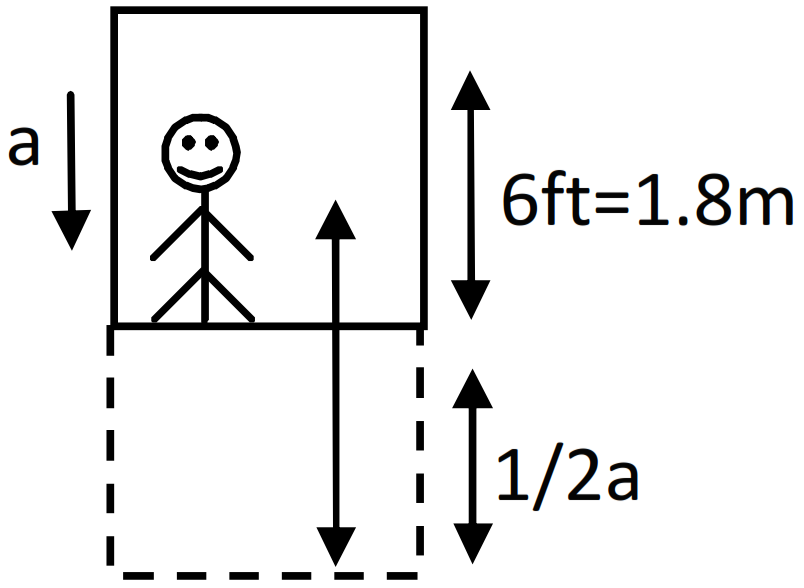
An elevator is descending with uniform acceleration. To measure the acceleration, a person in the elevator drops a coin at the moment the elevator starts. The coin is 6ft above the floor of the elevator at the time it is dropped. The person observes that the coin strikes the floor in 1 second. Calculate from these data the acceleration of the elevator.
Answer

For elevator and coin u = 0 As the elevator descends downward with acceleration a' (say) The coin has to move more distance than 1.8m to strike the floor. Time taken t = 1 sec.$\text{S}_{\text{c}}=\text{ut}+\frac{1}{2}\text{a}'\text{t}^2=0+\frac{1}{2}\text{g}(1)^2=\frac{1}{2}\text{g}$
$\text{S}_{\text{e}}=\text{ut}+\frac{1}{2}\text{at}^2=\text{u}+\frac{1}{2}\text{a}(1)^2=\frac{1}{2}\text{a}$
Total distance covered by coin is given by $=1.8+\frac{1}{2}\text{a}=\frac{1}{2}\text{g}$$\Rightarrow1.8+\frac{\text{a}}{2}=\frac{9.8}{2}=4.9$
$\Rightarrow\text{a}=6.2\text{m/s}^2=6.2\times3.28=20.34\text{ft/s}^2.$

Need a full question paper?

Generate a complete, print-ready paper with questions like this in minutes — across 16+ boards, with answer keys.

Start Generating Free

Similar questions

  1. State briefly the processes involved in the formation of p-n junction explaining clearly how the depletion region is formed.
  2. Using the necessary circuit diagrams, show how the V-I characteristics of a p-n junction are obtained in
  1. Forward biasing.
  2. Reverse biasing.
How are these characteristics made use of in rectification?
Explain how the image is formed by thin convex lens and derive $-\frac{1}{u}+\frac{1}{v}=\left(n_{21}-1\right)\left[\frac{1}{R_1}-\frac{1}{ R _2}\right] \#\#\# $ Derive lens maker's formula for thin convex lens.
Write the equation of average power for $L - C - R$ series $AC$ circuit and discuss its special cases.
Hydrogen spectrum consists of discrete bright lines in a dark background, and it is specifically known as hydrogen emission spectrum. There is one more type of hydrogen spectrum that exists where we get dark lines on the bright background, it is known as absorption spectrum. Balmer found an empirical formula by the observation of a small part of this spectrum, and it is represented by $\frac{1}{\lambda}=\text{R}\bigg(\frac{1}{2^2}-\frac{1}{\text{n}^2}\bigg)$ where n = 3, 4, 5 For Lyman series, the emission is from first state to $n^{th}$ state, for Paschen series, it is from third state to $n^{th}$ state, for Brackett series, it is from fourth state to $n^{th}$ state and for Pfund series, it is from fifth state to $n^{th}$ state.
  1. Number of spectral lines in hydrogen atom is:
  1. 8
  2. 6
  3. 15
  4. $\infty$
  1. Which series of hydrogen spectrum corresponds to ultraviolet region?
  1. Balmer series.
  2. Brackett series.
  3. Paschen series.
  4. Lyman series.
  1. Which of the following lines of the H-atom spectrum belongs to the Balmer series?
  1. 1025A
  2. 1218A
  3. 4861A
  4. 18751A
  1. Rydberg constant is.
  1. A universal constant.
  2. A universal constants.
  3. Different for different elements.
  4. None of these.
  1. Hydrogen atom is excited from ground state to another state with principal quantum number equal to 4. Then the number of spectral lines in the emission spectra will be.
  1. 3
  2. 5
  3. 6
  4. 2
A bird while flying takes a left turn, where does it get the centripetal force from?
When light of sufficiently high frequency is incident on a metallic surface, electrons are emitted from the metallic surface. TI1is phenomenon is called photoelectric emission. Kinetic energy of the emitted photoelectrons depends on the wavelength of incident tight and is independent of the intensity of light. Number of emitted photoelectrons depends on intensity. $(\text{h}\upsilon-\phi)$ is the maximum kinetic energy of emitted photoelectrons (where $\phi$ is the work function of metallic surface). Reverse effect of photo emission produces X-ray. X-ray is not deflected by electric and magnetic fields. Wavelength of a continuous X-ray depends on potential difference across the tube. Wavelength of characteristic X-ray depends on the atomic number.
  1. Einstein's photoelectric equation is:
  1. $\text{E}_\text{max}=\text{h}\upsilon-\phi$
  2. $\text{E}=\text{mc}^2$
  3. $\text{E}^2=\text{p}^2\text{c}^2+\text{m}_0^2\text{c}^4$
  4. $\text{E}=\frac{1}{2}\text{mv}^2$
  1. Light of wavelength $\lambda$ which is less than threshold wavelength is incident on a photosensitive material. If incident wavelength is decreased so that emitted photoelectrons are moving with some velocity then stopping potential will:
  1. Increase.
  2. Decrease.
  3. Be zero.
  4. Become exactly half.
  1. When ultraviolet rays incident on metal plate then photoelectric effect does not occur, it occur by incident of:
  1. Infrared rays
  2. X-rays
  3. Radio wave
  4. Micro wave
  1. If frequency $(\upsilon>\upsilon_0)$ of incident light becomes n times the initial frequency $(\upsilon)$, then K.E. of the emitted photoelectrons becomes ($\upsilon_0$ threshold frequency).
  1. N times of the initial kinetic energy.
  2. More than n times of the initial kinetic energy.
  3. Less than n times of the initial kinetic energy.
  4. Kinetic energy of the emitted photoelectrons remains unchanged.
  1. A monochromatic light is used in a photoelectric experiment. The stopping potential.
  1. Is related to the mean wavelength.
  2. Is related to the shortest wavelength.
  3. Is not related to the minimum kinetic energy of emitted photoelectrons.
  4. Intensity of incident tight.
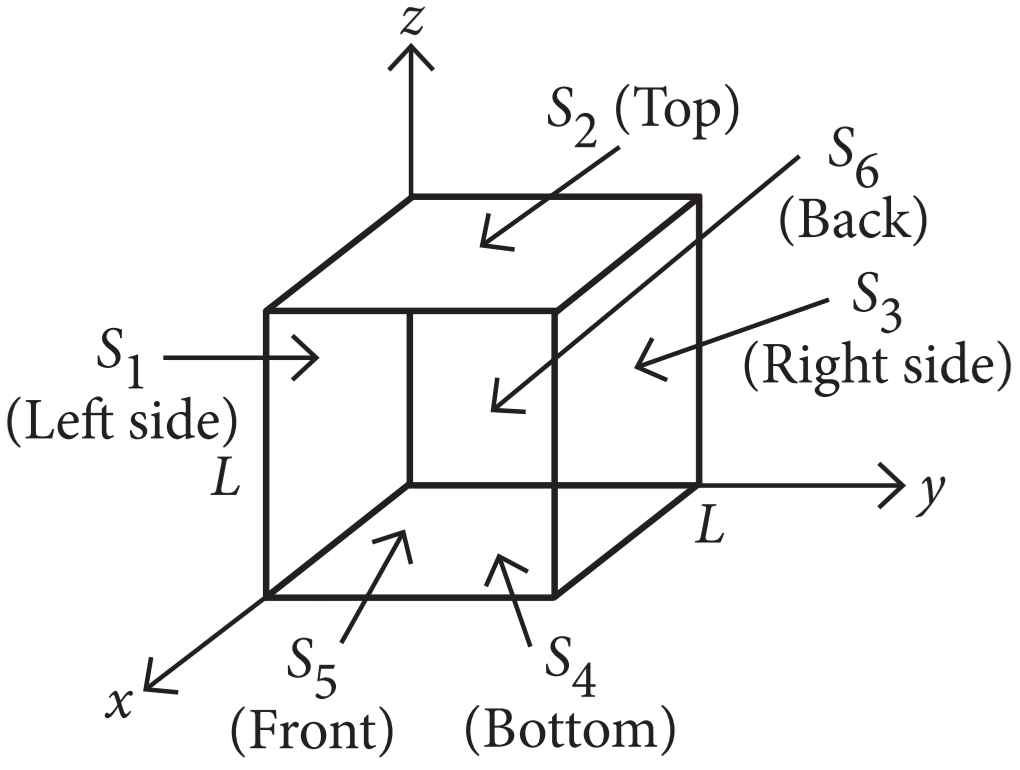
Net electric flux through a cube is the sum of fluxes through its six faces. Consider a cube as shown in figure, having sides of length L = 10.0cm. The electric field is uniform, has a magnitude $E = 4.00 \times 10^3N C^{-1}$ and is parallel to the xy plane at an angle of 37º measured from the + x - axis towards the + y - axis.
  1. Electric flux passing through surface $S_6$ is:
  1. $-24N\ m^2C^{-1}$
  2. $24N\ m^2C^{-1}$
  3. $32N\ m^2C^{-1}$
  4. $-32N\ m^2C^{-1}$
  1. Electric flux passing through surface $S_1$ is:
  1. $-24N\ m^2C^{-1}$
  2. $24N\ m^2 C^{-1}$
  3. $32N\ m^2 C^{-1}$
  4. $-32N\ m^2 C^{-1}$
  1. The surfaces that have zero flux are:
  1. $S_1$ and $S_3$
  2. $S_5$ and $S_6$
  3. $S_2$ and $S_4$
  4. $S_1$ and $S_2$
  1. The total net electric flux through all faces of the cube is:
  1. 8N $m^2\ C^{-1}$
  2. -8N $m^2\ C^{-1}$
  3. 24N $m^2\ C^{-1}$
  4. Zero.
  1. The dimensional formula of surface integral $\oint\vec{\text{E}}\cdot\text{d}\vec{\text{S}}$ of an electric field is:
  1. $[M\ L^2T^{-2} A^{-1}]$
  2. $[M\ L^3T^{-3} A^{-1}]$
  3. $[M\ L^{-1}T^3 A^{-3}]$
  4. $[M\ L^{-3}T^{-3} A^{-1}]$
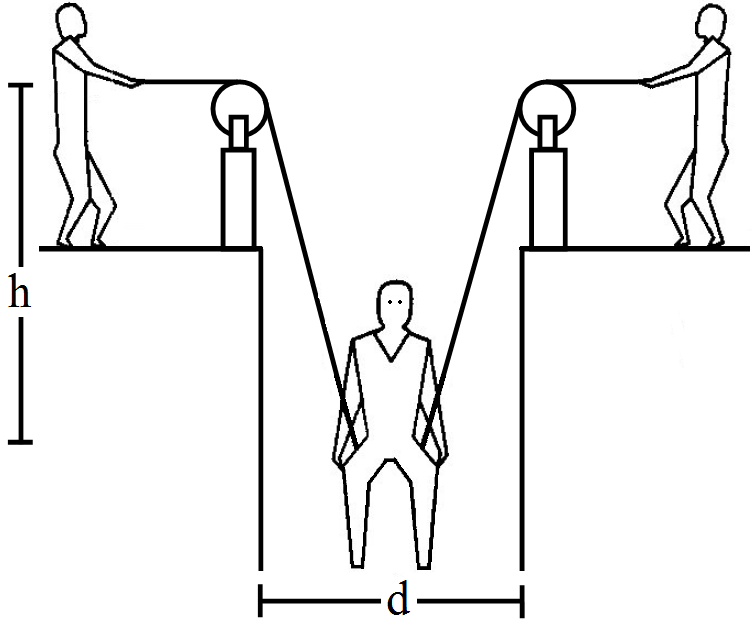
A man has fallen into a ditch of width d and two of his friends are slowly pulling him out using a light rope and two fixed pulleys as shown in figure. Show that the force (assumed equal for both the friends) exerted by each friend on the road increases as the man moves up. Find the force when the man is at a depth h.
A photodiode is an optoelectronic device in which current carriers are generated by photons through photo-excitation i.e., photo conduction by light. It is a p-n junction fabricated from a photosensitive semiconductor and provided with a transparent window so as allow light to fall on its function. A photodiode can turn its current ON and OFF in nanoseconds. So, it can be used as a fastest photo-detector.
  1. A p-n photodiode is fabricated from a semiconductor with a band gap of 2.5eV. It can detect a signal of wavelength:
  1. 4000nm.
  2. 6000nm.
  3. 4000Â.
  4. 6000Â.
  1. Three photo diodes $D_1, D_2$ and $D_3$ are made of semiconductors having band gap of 2.5eV, 2eV, and 3 eV, respectively. Which one will be able to detect light of wavelength 6000Â?
  1. $D_1$
  2. $D_2$
  3. $D_3$
  4. $D_1$ and $D_2$ both.
  1. Photodiode is a device:
  1. Which is always operated in reverse bias.
  2. Which of always operated in forward bias.
  3. In which photo current is independent of intensity of incident radiation.
  4. Which may be operated in forward or reverse bias.
  1. To detect light of wavelength 500nm, the photodiode must be fabricated from a semiconductor of minimum bandwidth of:
  1. 1.24eV
  2. 0.62eV
  3. 2.48eV
  4. 3.2eV
  1. Photodiode can be used as a photodetector to detect:
  1. Optical signals.
  2. Electrical signals.
  3. Both (a) and (b).
  4. None of these.
A transformer is essentially an a.c. device. It cannot work on d.c. It changes altemating voltages or currents. It does not affect the frequency of a.c. It is based on the phenomenon of mutual induction. A transformer essentially consists of two coils of insulated copper wire having different number of tums and wound on the same soft iron core.
The number of turns in the primary and secondary coils of an ideal transfonner are 2000 and 50 respectively. The primary coil is connected to a main supply of 120V and secondary coil is connected to a bulb of resistance $0.6\Omega.$
  1. The value of voltage across the secondary coil is:
  1. 5V
  2. 2V
  3. 3V
  4. 10V
  1. The value of current in the bulb is:
  1. 7A
  2. 15A
  3. 3A
  4. 5A
  1. The value of current in primary coil is:
  1. 0.125A
  2. 2.52A
  3. 1.51A
  4. 3.52A
  1. Power in primary coil is:
  1. 20W
  2. 5W
  3. 10W
  4. 15W
  1. Power in secondary coil is:
  1. 15W
  2. 20W
  3. 7W
  4. 8W