MCQ
An elevator is going down with a constant acceleration. A coin dropped from a point $1.8m$ above the elevator floor takes one second to reach the floor. The magnitude of the acceleration of the the elevator in $ms^{-2}$ is: Given: $g = 10\ ms^{-2}$ 
  • A
    $3.6$
  • B
    $5$
  • C
    $7.2$
  • $6.4$

Answer

Correct option: D.
$6.4$

Need a full question paper?

Generate a complete, print-ready paper with questions like this in minutes — across 16+ boards, with answer keys.

Start Generating Free

Similar questions

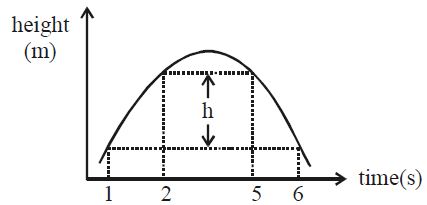
A ball is thrown upwards. Its height varies with time as follows If the acceleration due to gravity is $7.5\, m/s^2$, then the height $h$ is.........$m$
The orbital speed of an artificial satellite in a circular orbit just above the earth's surface is $v$. For a satellite orbiting at an altitude of half the earth's radius the orbital speed is:
Two adjacent sides of a parallelogram are represented by the two vectors $\hat i + 2\hat j + 3\hat k$ and $3\hat i - 2\hat j + \hat k$. What is the area of parallelogram
A hydraulic press can lift $100\, kg$ when a mass $'m'$ is placed on the smaller piston. It can lift ......... $kg$ when the diameter of the larger piston is increased by $4$ times and that of the smaller piston is decreased by $4$ times keeping the same mass $'m'$ on the smaller piston.
The height upto which water will rise in a capillary tube will be
The potential energy in joules of a particle of mass $1\, kg$ moving in a plane is given by $U = 3x + 4y$, the position coordinates of the point being $x$ and $y$, measured in metres. If the particle is initially at rest at $(6,4)$, then
A student measured the diameter of a wire using a screw gauge with the least count $0.001\, cm$ and listed the measurements. The measured value should be recorded as
Wave has simple harmonic motion whose period is $4\; sec$ while another wave which also possesses simple harmonic motion has its period $3\; sec$. If both are combined, then the resultant wave will have the period equal to ....... $sec$
Water rises upto $10\, cm$ height in a long capillary tube. If this tube is immersed in water so that the height above the water surface is only $8 \,cm,$  then
The variation of the acceleration $a$ of the particle executing $S.H.M.$ with displacement $x$ is as shown in the figure