Question
An ellipsometer is an instrument for.

Answer

  1. Studying thin films on a solid surface.
Explanation:
An ellipsometer is a device used for studying thin films on a solid surface.
Ellipsometry is an optical technique for investigating the di electric properties of thin films.

Need a full question paper?

Generate a complete, print-ready paper with questions like this in minutes — across 16+ boards, with answer keys.
Start Generating Free

Similar questions

Brewster's law is :
Assertion  :  A narrow pulse of light is sent through a medium. The pulse will  retain its shape as it travels through the medium.
Reason      : A narrow pulse is made of harmonic waves with a large range of wavelengths.(a) If both assertion and reason are true and the reason is the correct explanation of the assertion.(b) If both assertion and reason are true but reason is not the correct explanation of the assertion.(c) If assertion is true but reason is false.(d) If assertion is false but reason is true.


In the given nuclear reaction $\ce{A, B, C, D, E}$ represents $92^{\mathrm{U}^{2 \mathrm{~s}}} \xrightarrow{\alpha} \mathrm{~B}^{\mathrm{Th}^{\mathrm{A}}} \xrightarrow{\beta} \mathrm{D}^{\mathrm{Pa}^{\mathrm{C}}} \xrightarrow{\mathrm{E}} 92^{\mathrm{U}^{2 \mathrm{~s}} 4}$
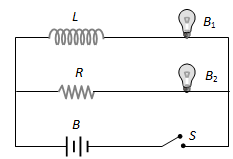
An inductor, $L$ a resistance $R$ and two identical bulbs $,\mathrm{B}_1$ and $\mathrm{B}_2$ are connected to a battery through a switch $S$ as shown in the figure. The resistance $R$ is the same as that of the coil that makes $L .$ Which of the following statements gives the correct description of the happenings when the switch $S$ is closed
When ultraviolet rays fall on the surface of metal, photoelectric effect does not occur but the following will casue :
A source of electromotive force (emf) is a:
The log$-$log graph between the energy $E$ of an electron and its de$-$Broglie wavelength $\lambda$  will be
The unit of susceptance is.
In Young’s double slit experiment, the central bright fringe can be identified(a) By using white light instead of monochromatic light(b) As it is narrower than other bright fringes(c) As it is wider than other bright fringes (d) As it has a greater intensity than the other bright fringes


Consider the following two equations:
  1. $\overrightarrow{\text{R}}=\frac{1}{\text{M}}\sum\limits_{\text{i}}\text{m}_\text{i}\overrightarrow{\text{r}}_\text{i}$
  2. $\overrightarrow{\text{a}}_\text{cm}=\frac{\overrightarrow{\text{F}}}{\text{M}}$
In a noninertial frame
  1. Both are correct.
  2. Both are wrong.
  3. A is correct but B is wrong.
  4. B is correct but A is wrong.