MCQ
An engineer is given a fixed volume $V_m$ of metal with which to construct a spherical pressure vessel. Interestingly, assuming the vessel has thin walls and is always pressurized to near its bursting point, the amount of gas the vessel can contain, $n$ (measured in moles), does not depend on the radius $r$ of the vessel : instead it depends only on $V_m$ (measured in $m^3$) the temperature $T$ (mensured in $K$). the ideal gas constant $R$ (measured in $J/(K\ mol$ )), and the tensile strength of the metal $\sigma $ (measured in $N/m^2$ ) . Which of the following gives $n$ in terms of these parameters?
  • $n = \frac{2}{3}\,\frac{{{V_m}\sigma }}{{RT}}$
  • B
    $n = \frac{2}{3}\,\frac{{\sqrt[3]{{{V_m}\sigma }}}}{{RT}}$
  • C
    $n = \frac{2}{3}\,\frac{{\sqrt[3]{{{V_m}{\sigma ^2}}}}}{{RT}}$
  • D
    $n = \frac{2}{3}\,\frac{{\sqrt[3]{{{V_m}^2\sigma }}}}{{RT}}$
Answer

Correct option: A.
$n = \frac{2}{3}\,\frac{{{V_m}\sigma }}{{RT}}$
a
By dimensional analysis

Need a full question paper?

Generate a complete, print-ready paper with questions like this in minutes — across 16+ boards, with answer keys.

Start Generating Free

Similar questions

A tuning fork produces waves in a medium. If the temperature of the medium changes, then which of the following will change
The temperature of a gas having $2.0 \times 10^{25}$ molecules per cubic meter at $1.38 \mathrm{~atm}$ (Given, $\mathrm{k}=$ $\left.1.38 \times 10^{-23} \mathrm{JK}^{-1}\right)$ is :
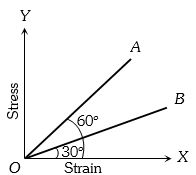
The stress versus strain graphs for wires of two materials $A$ and $B$ are as shown in the figure. If ${Y_A}$ and ${Y_B}$ are the Young ‘s modulii of the materials, then
A body is rotating with angular velocity $\omega=(3\hat{\text{i}}-4\hat{\text{j}}-\hat{\text{k}})$ The linear velocity of a point having position vector $\text{r}=(5\hat{\text{i}}-6\hat{\text{j}}+6\hat{\text{k}})$ is:
The rate of steady volume flow of water through a capillary tube of length $ 'l' $ and radius $ 'r' $ under a pressure difference of $P$  is $V$. This tube is connected with another tube of the same length but half the radius in series. Then the rate of steady volume flow through them is (The pressure difference across the combination is $ P$)
A particle of mass $5 \;\mathrm{m}$ at rest suddenly breaks on its own into three fragments. Two fragments of mass $m$ each move along mutually perpendicetion with speed $v$ each. The energy released during the process is
An aeroplane is flying at a constant horizontal velocity of $600\, km/hr $ at an elevation of $6\, km$ towards a point directly above the target on the earth's surface. At an appropriate time, the pilot releases a ball so that it strikes the target at the earth. The ball will appear to be falling
Which one of the following statements is not true about the motion of a projectile?
If the mass of the Sun were ten times smaller  and the universal gravitational constant were ten times larger in magnitude, which of the following is not correct? 
$Assertion :$ Reversible systems are difficult to find in real world.
$Reason :$ Most processes are dissipative in nature.