MCQ
An express train is moving with a velocity $v$. Its driver finds another train is moving on the same track in the same direction with velocity $v$. To escape collision, driver applies a retardation $a$ on the train. the minimum time of escaping collision will be
  • $t=\frac{v_1-v_2}{a}$
  • B
    $t_1=\frac{v_1^2-v_2^2}{2}$
  • C
    None
  • D
    (A) and (B) Both

Answer

Correct option: A.
$t=\frac{v_1-v_2}{a}$
As the trains are moving in the same direction. So the initial relative speed $(\left(v_1-v_2)\right)$ and by applying retardation final relative speed becomes zero.
From $v=u-a t \Rightarrow 0=\left(v_1-v_2\right)-a t \Rightarrow t=\frac{v_1-v_2}{a}$

Need a full question paper?

Generate a complete, print-ready paper with questions like this in minutes — across 16+ boards, with answer keys.

Start Generating Free

Similar questions

In the motion of a projectile freely under gravity, its
A magnetic needle lying parallel to a magnetic field requires $W$ units of work to turn it through $60^{\circ}$. The torque required to maintain the needle in this position will be
If the kinetic energy of a body becomes four times of its initial value, then new momentum will
"Heat cannot by itself flow from a body at lower temperature to a body at higher temperature" is a statement or consequence of
Unit of moment of inertia in MKS system
A body takes 4 minutes to cool from $100^{\circ} \mathrm{C}$ to $70^{\circ} \mathrm{C}$. To cool from $70^{\circ} \mathrm{C}$ to $40^{\circ} \mathrm{C}$ it will take (room temperature is $15^{\circ} \mathrm{C}$ )
light waves producing interference have their amplitudes in the ratio $3: 2$. The intensity ratio of maximum and minimum of interference fringes is
A force $(\vec{F})=3 \hat{i}+\hat{c j}+2 \hat{k}$ acting on a particle causes a displacement: $(\vec{s})=-4 \hat{i}+2 \hat{j}+3 \hat{k}$ in its own direction. If the work done is $6 J$, then the value of ' $c$ ' is
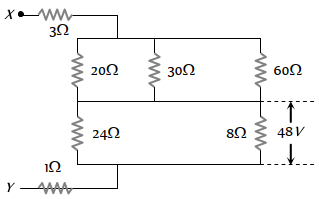
The potential difference across $8 \mathrm{ohm}$ resistance is $48 \mathrm{volt}$ as shown in the figure. The value of potential difference across $X$ and $\gamma$ points will be
Image
Two waves having equations
$ x_1=a \sin \left(\omega t+\phi_1\right), x_2=a \sin \left(\omega t+\phi_2\right)$
If in the resultant wave the frequency and amplitude remain equal to those of superimposing waves. Then phase difference between them is