Question
An ideal diode should pass a current freely in one direction and should stop it completely in the opposite direction. Which is closer to ideal-vacuum diode or a p-n junction diode?

Answer

It should be an ideal vacuum diode. When a p-n junction diode is reverse biassed then a small current called reverse current flows across the diode. As the the p‒n junction diode allows some current in reverse biassed condition also so the given diode cannot be a p-n junction diode.

Need a full question paper?

Generate a complete, print-ready paper with questions like this in minutes — across 16+ boards, with answer keys.
Start Generating Free

Similar questions

A galvanometer coil has a resistance of $12 \Omega$ and the metre shows full scale deflection for a current of $3 m$ A. How will you convert the metre into a voltmeter of range $0$ to $18 V$?
Write and explain principle of superposition for stationary electric forces.
A light ray falling at an angle of $45^\circ$ with the surface of a clean slab of ice of thickness $1m$ is refracted into it at an angle of $30^\circ$ . Calculate the time taken by the light rays, to cross the slab. Speed of light in vacuum $= 3 \times 10^8\ m/s$
A zener diode is fabricated by heavily doping both $p-$ and $n-$ sides of the junction. Explain, why? Briefly explain the use of zener diode as a de voltage regulator with the help of a circuit diagram.
An ac genrator is made from area of cross section $3 m^2$ and a coil of 100 turns which is rotated by a constant angular velocity of $60 rad / s$ in a magnetic field of 0.04 T . Resistance of the coil is $500 \Omega$ Calculate: (i) maxumum current obtained from the generator and (ii) maximum power dissipated in the coil.
A ball of mass $0.50\ kg$ moving at a speed of $5.0\ m/s$ collides with another ball of mass $1.0\ kg.$ After the collision the balls stick together and remain motionless. What was the velocity of the $1.0\ kg$ block before the collision?
Define the current sensitivity of a galvanometer. Write its $S.I.$ unit.
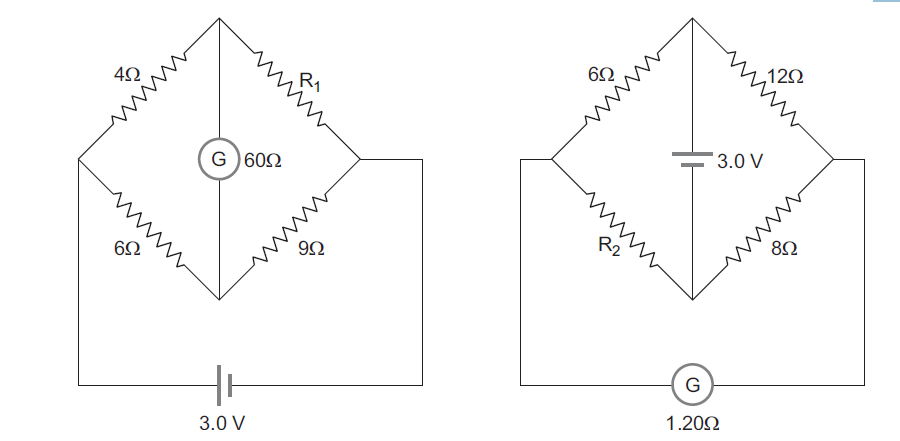
Figure shows two circuits each having a galvanometer and a battery of $3 V. $ When the galvanometers in each arrangement do not show any deflection, obtain the ratio $R_{1 }/ R_2.$
A cylinder containing a gas is lifted from the first floor to the second floor. What is the amount of work done on the gas? What is the amount of work done by the gas? Is the internal energy of the gas increased? Is the temperature of the gas increased?
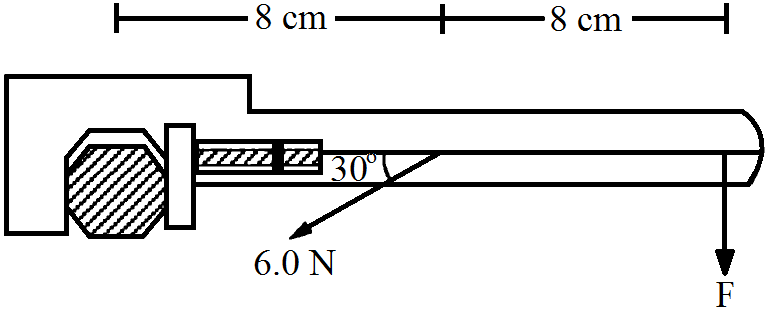
When a force of 6.0N is exerted at 30° to a wrench at a distance of 8cm from the nut, it is just able to loosen the nut. What force F would be sufficient to loosen it if it acts perpendicularly to the wrench at 16cm from the nut?
A parallel$-$plate capacitor with plate area $20\ cm^2$ and plate separation $1.0\ mm$ is connected to a battery. The resistance of the circuit is $10\text{k}\Omega.$ Find the time constant of the circuit.