Question
An ideal diode should pass a current freely in one direction and should stop it completely in the opposite direction. Which is closer to ideal-vacuum diode or a p-n junction diode?

Answer

It should be an ideal vacuum diode. When a p-n junction diode is reverse biassed then a small current called reverse current flows across the diode. As the the p‒n junction diode allows some current in reverse biassed condition also so the given diode cannot be a p-n junction diode.

Need a full question paper?

Generate a complete, print-ready paper with questions like this in minutes — across 16+ boards, with answer keys.
Start Generating Free

Similar questions

Use Huygens's principle to explain the formation of diffraction pattern due to a single slit illuminated by a monochromatic source of light.
When the width of the slit is made double the original width, how would this affect the size and intensity of the central diffraction band?
A man uses a concave mirror for shaving. He keeps his face at a distance of 25cm from the mirror and gets an image which is 1.4 times enlarged. Find the focal length of the mirror.
A square loop of side $10 \ cm$ and resistance $0.5 \Omega$ is placed vertically in the east $-$ west plane. $A$ uniform magnetic field of $0.10 T$ is set up across the plane in the north-east direction. The magnetic field is decreased to zero in $0.70 s$ at a steady rate. Determine the magnitudes of induced emf and current during this time $-$ interval.
What is the radius of curvature of the parabola traced out by the projectile in the previous problem at a point where the particle velocity makes an angle $\frac{\theta}{2}$ with the horizontal?
Prove that the force acting on a current-carrying wire, joining two fixed points a and b in a uniform magnetic field, is independent of the shape of the wire.
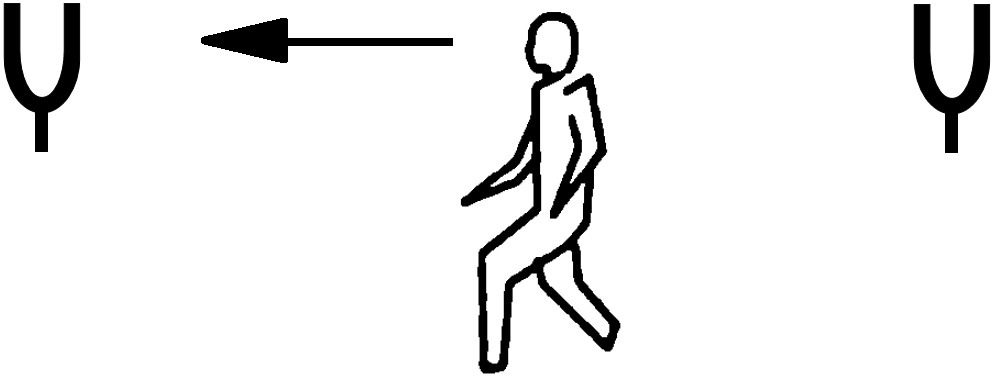
Two identical tuning forks vibrating at the same frequency $256\ Hz$ are kept fixed at some distance apart. $A$ listener runs between the forks at a speed of $3.0\ m/s$ so that he approaches one tuning fork and recedes from the other figure. Find the beat frequency observed by the listener. Speed of sound in air $= 332\ ms/s.$
The band gap between the valence and the conduction bands in zinc oxide (ZnO) is 3.2eV. Suppose an electron in the conduction band combines with a hole in the valence band and the excess energy is released in the form of electromagnetic radiation. Find the maximum wavelength that can be emitted in this process.
(i) What is meant by electric power? Prove that $P=\frac{V^2}{R}$ or $P=I^2 R$. Define one-watt electric power.(ii) Define electric energy. Prove that $P = I ^2 R \Delta t$
Obtain essential expression for balanced position of Wheatstone Bridge.###Explain the principle of Wheatstone Bridge. How can we find the resistance of any resistor using this principle?
Is inversion temperature always double of the neutral temperature? Does the unit of temperature have an effect in deciding this question?