MCQ
An ideal gas at atmospheric pressure is adiabatically compressed so that its density becomes $32$ times of its initial value. If the final pressure of gas is $128$ atmosphers, the value of $\gamma$ the gas is
  • A
    $1.5$
  • $1.4$
  • C
    $1.3$
  • D
    $1.6$

Answer

Correct option: B.
$1.4$
b
Volume of the gas

$v=\frac{m}{d}$ and

using $P V^{7}=$ constant

$\frac{P^{\prime}}{P}=\frac{V}{V^{\prime}}=\left(\frac{d^{\prime}}{d}\right)^{\gamma}$

$\alpha 128=(32)^{\gamma}$

$\gamma=\frac{7}{5}=1.4$

Need a full question paper?

Generate a complete, print-ready paper with questions like this in minutes — across 16+ boards, with answer keys.

Start Generating Free

Similar questions

The dimensions of surface tension are
A stone is dropped into well in which the level of water is at a distance $h$ below the top of well. If $y$ is the velocity of sound, the time $T$ after which the splash is heard is given by:
A capillary tube of radius $r$ is immersed in water and water rises in it to a helght $h$. The mass of the water in the capillary is $5\,g.$ Another capillary tube of radlus $2\, r$ is immersed in water. The mass of water that will rise in this tube is $........\;g$
A tangent galvanometer is connected directly to an ideal battery. If the number of turns in the coil is doubled the deflection will:
The temperature at which the $\text{r.m.s.}$ velocity of $H^2$ becomes escape velocity from the earth is,
A student uses a simple pendulum of exactly $1 \mathrm{~m}$ length to determine $\mathrm{g}$, the acceleration due to gravity. He uses a stop watch with the least count of $1 \mathrm{sec}$ for this and records $40$ seconds for $20$ oscillations. For this observation, which of the following statement$(s)$ is (are) true?

$(A)$ Error $\Delta T$ in measuring $T$, the time period, is $0.05$ seconds

$(B)$ Error $\Delta \mathrm{T}$ in measuring $\mathrm{T}$, the time period, is $1$ second

$(C)$ Percentage error in the determination of $g$ is $5 \%$

$(D)$ Percentage error in the determination of $g$ is $2.5 \%$
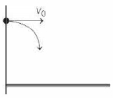
Two balls of mass $M$ and $2 \,M$ are thrown horizontally with the same initial velocity $v_{0}$ from top of a tall tower and experience a drag force of $-k v(k > 0)$, where $v$ is the instantaneous velocity. then,
The slope of the straight line connecting the points corresponding to $(v_2, t_2)$ and $(v_1, t_1)$ on a plot of velocity versus time gives:
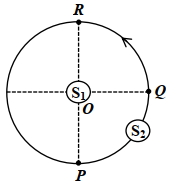
$S_1$ and $S_2$ are two identical sound sources of frequency $656 Hz$. The source $S_1$ is located at $O$ and $S_2$ moves anti-clockwise with a uniform speed $4 \sqrt{2} ms ^{-1}$ on a circular path around $O$, as shown in the figure. There are three points $P, Q$ and $R$ on this path such that $P$ and $R$ are diametrically opposite while $Q$ is equidistant from them. A sound detector is placed at point $P$. The source $S_1$ can move along direction $O P$.

[Given: The speed of sound in air is $324 ms ^{-1}$ ]

($1$) When only $S_2$ is emitting sound and it is $Q$, the frequency of sound measured by the detector in $Hz$ is. . . . . .

($2$) Consider both sources emitting sound. When $S_2$ is at $R$ and $S_1$ approaches the detector with a speed $4 ms ^{-1}$, the beat frequency measured by the detector is $\qquad$ $Hz$.
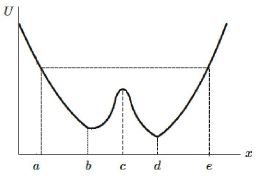
A particle is released from rest at the point $x = a$ and moves along the $x$ axis subject to the potential energy function $U(x)$ shown. The particle: