Question
An ideal gas $\Big(\frac{\text{C}_\text{P}}{\text{C}_\text{V}}=\gamma\Big)$ is taken through a process in which the pressure and the volume vary as $p = aV^b$. Find the value of b for which the specific heat capacity in the process is zero.

Answer

$\frac{\text{C}_\text{P}}{\text{C}_\text{V}}=\gamma,\ \text{C}_\text{p}-\text{C}_\text{V}=\text{R},$
$\text{C}_\text{V}=\frac{\text{r}}{\gamma-1},​​​​\text{C}_\text{P}=\frac{\gamma\text{R}}{\gamma-1}$
$\text{Pdv}=\frac{1}{\text{b}+1}(\text{Rdt})$
$\Rightarrow0=\text{C}_\text{V}\text{dT}+\frac{1}{\text{b}+1}(\text{Rdt})$
$\Rightarrow\frac{1}{\text{b}+1}=\frac{-\text{C}_\text{V}}{\text{R}}$
$\Rightarrow\text{b}+1=\frac{-\text{R}}{\text{C}_\text{V}}=\frac{-(​​\text{C}_\text{P}-\text{C}_\text{V})}{\text{C}_\text{V}}=-\gamma+1$
$\Rightarrow\text{b}=-\gamma$

Need a full question paper?

Generate a complete, print-ready paper with questions like this in minutes — across 16+ boards, with answer keys.
Start Generating Free

Similar questions

An electric bulb is designed to operate at 12 volts DC. If this bulb is connected to an AC source and gives normal brightness, what would be the peak voltage of the source?
In a plot of photoelectric current versus anode potential, how does?
  1. The saturation current vary with anode potential for incident radiations of different frequencies but same intensity?
  2. The stopping potential vary for incident radiations of different intensities but same frequency?
  3. Photoelectric current vary for different intensities but same frequency of incident radiations?
Justify your answer in each case.
An object P is focused by a microscope M. A glass slab of thickness 2.1cm is introduced between P and M. If the refractive index of the slab is 1.5, by what distance should the microscope be shifted to focus the object again?
  1. Define self inductance. Write its S.I. units.
  2. Derive an expression for self inductance of a long, solenoid of length l, cross sectional area A having N number of turns.
Estimate the proportion of boron impurity whieh will increase the conductivity of a pure silicon sample by a factor of 100. Assume that each boron atom creates a hole and the concentration of holes in pure silicon at the same temperature is $7 \times 10^{15}$ holes per cubic metre. Density of silicon is $5 \times 10^{21}$ atoms per cubic metre.
Draw V – I characteristics of a p–n junction diode. Answer the following questions, giving reasons:
  1. Why is the current under reverse bias almost independent of the applied potential up to a critical voltage?
  2. Why does the reverse current show a sudden increase at the critical voltage?
Name any semiconductor device which operates under the reverse bias in the breakdown region.
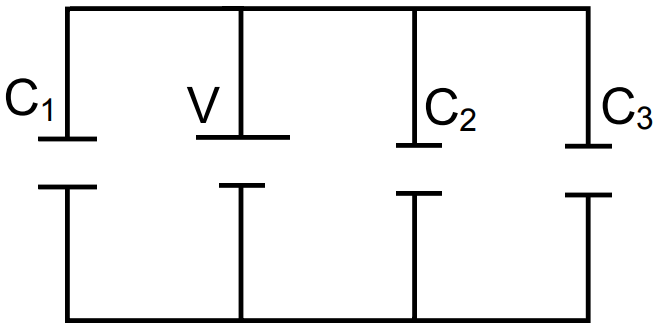
Find the charges on the three capacitors connected to a battery as shown in figure. Take $\text{C}_1=2.0\mu\text{F},\ \text{C}_2=4.0\mu\text{F},\ \text{C}_3=6.0\mu\text{F}$ and V = 12 volts.
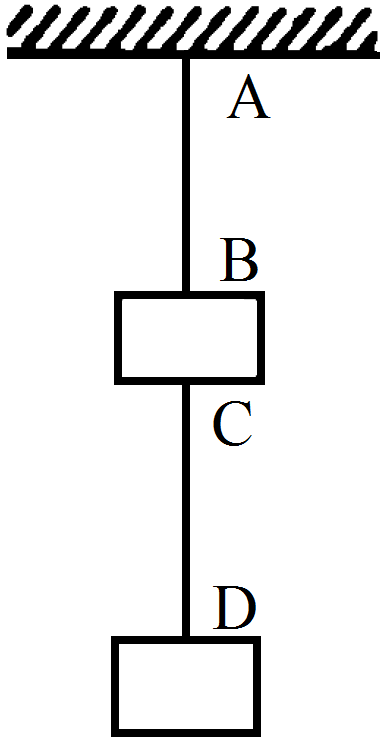
Two blocks each having a mass of 3.2kg are connected by a wire CD and the system is suspended from the ceiling by another wire AB figure, The linear mass delity of the wire AB is 10g/m and that of CD is 8g/m. Find the speed of a transverse wave pulse produced in AB and in CD.
An electric bulb of volume 250cc was sealed during manufacturing at a pressure of $10^{-3}mm$ of mercury at $27^\circ C.$ Compute the number of air molecules contained in the bulb. Avogadro constant $= 6 \times 10^{23}mol^{-1}$, density of mercury $= 13600kg/ m^{-3} and g = 10ms^{-2}.$
Two small bodies of masses 10kg and 20kg are kept a distance 1.0m apart and released, Assuming that only mutual gravitational forces are acting, find the speeds of the particles when the separation decreases to 0.5m.