MCQ
An ideal gas undergoes isothermal process from some initial state $i$ to final state $f.$ Choose the correct alternatives.
  • A
    $dU = 0$
  • B
    $\text{dQ = dW}$
  • C
    $\text{dQ = dU}$
  • Both $A$ and $B$

Answer

Correct option: D.
Both $A$ and $B$
Key concept: First Law of Thermodynamics.
It is a statement of conservation of energy in thermodynamical process.
According to it heat given to a system $(\Delta\text{Q})$ is equal to the sum of increase in its internal energy $\text{(AIT)}$ and the work done $\text{(AW)}$ by the system against the surroundings.
$\Delta\text{Q}=\Delta\text{U}+\Delta\text{W}$
According to the first law of thermodynamics. $\Delta\text{A}\text{Q}=\Delta\text{U}+\Delta\text{W}$ but
$\Delta\text{U}\propto\Delta\text{T}$
$\Delta\text{U}=0[$As $\Delta\text{T}=0]$
$\Delta\text{Q}=\Delta\text{W}$,
i.e., heat supplied in an isothermal change is used to do work against external surrounding or if the work is done on the system then equal amount of heat energy will be liberated by the system

Need a full question paper?

Generate a complete, print-ready paper with questions like this in minutes — across 16+ boards, with answer keys.
Start Generating Free

Similar questions

A drop of mercury of radius $2\, mm$ is split into $8$ identical droplets. Find the increase in surface energy ....... $\mu J$. (Surface tension of mercury is $0.465\;J/{m^2}$)
If a car at rest accelerates uniformly to a speed of $144 \,km/h$ in $20 \,s$. Then it covers a distance of........$m$
A particle of mass $m$ moving in the $x$ direction with speed $2 v$ is hit by another particle of mass $2 m$ moving in the $y$ direction with speed $v$. If the collision is perfectly inelastic, the percentage loss in the energy during the collision is close to $..........\%$
A thin uniform circular disc of mass $M$ and radius $R$ is rotating in a horizontal plane about an axis passing through its centre and perpendicular to the plane with angular velocity $\omega$. Another disc of same mass but half the radius is gently placed over it coaxially. The angular speed of the composite disc will be :
Two forces are such that the sum of their magnitudes is $18 \,N$ and their resultant is perpendicular to the smaller force and magnitude of resultant is $12\, N$. Then the magnitudes of the forces are
A sphere, a cube and a disc all of the same material, quality and volume are heated to $600\,^oC$ and left in air. Which of these will have the lowest rate of cooling ?
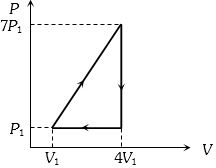
In the cyclic process shown in the figure, the work done by the gas in one cycle is
According to the following graph, what happens to the distance covered by the body from $0 -10$ minutes?
A car is moving on a circular path of radius $600\,m$ such that the magnitudes of the tangential acceleration and centripetal acceleration are equal. The time taken by the car to complete first quarter of revolution, if it is moving with an initial speed of $54\,km / hr$ is $t \left(1- e ^{-\pi / 2}\right)\,s$. The value of $t$ is $.............$.
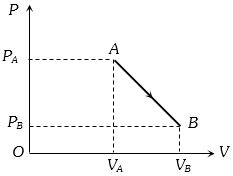
An ideal gas is taken from point $A$ to the point $B,$ as shown in the $P-V$ diagram, keeping the temperature constant. The work done in the process is