Question
An ideal thermometer should have

Answer

(c) The thermometer has to attain the temperature of the body. To do this, it should draw as little heat from the body as possible, so that the existing temperature of the body is not disturbed.

Need a full question paper?

Generate a complete, print-ready paper with questions like this in minutes — across 16+ boards, with answer keys.
Start Generating Free

Similar questions

The amount of heat energy required to raise the temperature of $1\, g$ of Helium at  $NTP,$ from $T_1 K$ to $T_2 K$ is 
Two forces ${F_1} = 1\,N$ and ${F_2} = 2\,N$ act along the lines $x = 0$ and $y = 0$ respectively. Then the resultant of forces would be
The position of a particle moving along $x$-axis is given by $x=10 t-2 t^2$. Then the time $(t)$ at which it will momently come to rest is .......... $s$
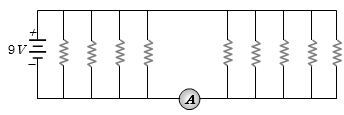
If each resistance in the figure is of $9\,\Omega$ then reading of ammeter is ............ $A$
A closed organ pipe $150 \mathrm{~cm}$ long gives $7$ beats per second with an open organ pipe of length $350 \mathrm{~cm}$, both vibrating in fundamental mode. The velocity of sound is_________ $\mathrm{m} / \mathrm{s}$.
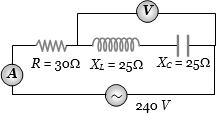
In the circuit shown in figure neglecting source resistance the voltmeter and ammeter reading will respectively, will be
A series $R-C$ combination is connected to an $AC$ voltage of angular frequency $\omega=500 \ radian / s$. If the impedance of the $R-C$ circuit is $R \sqrt{1.25}$, the time constant (in millisecond) of the circuit is
There is an air bubble of radius $1.0\,mm$ in a liquid of surface tension $0.075\,Nm ^{-1}$ and density $1000\,kg$ $m ^{-3}$ at a depth of $10\,cm$ below the free surface. The amount by which the pressure inside the bubble is greater than the atmospheric pressure is $....Pa \left( g =10\,ms ^{-2}\right)$
If one face of a prism of prism angle $30^o$ and $\mu  = \sqrt 2 $ is silvered, the incident ray retraces its initial path. The angle of incidence is.......$^o$
The displacement of a particle, moving in a straight line, is given by $s = 2{t^2} + 2t + 4$ where $s$ is in metres and $t$ in seconds. The acceleration of the particle is........$ms^{-2}$