Question

An interference pattern was made by using red light. If the red light changes with blue light, the fringes will become

(a) Wider  

(b) Narrower

(c) Fainter

(d) Brighter

Answer

(b) Narrower

Need a full question paper?

Generate a complete, print-ready paper with questions like this in minutes — across 16+ boards, with answer keys.

Start Generating Free

Similar questions

Field lines are shown close together where the

The photoelectric threshold wavelength of a certain metal is 3000Å. If the radiation of 2000Å is incident on the metal

(a) Electrons will be emitted

(b) Positrons will be emitted

(c) Protons will be emitted

(d) Electrons will not be emitted

A Solid sphare of radius R has a charge Q distributed in its Volume with a charge density P = Kra Where K and a are constants and r is the distance from its centre from its centre. if the electric filed at $\text{r}=\frac{\text{R}}{2}$ is $\frac{1}{8}$ times that at r = R, the value of a is.
The nuclear fusion reaction between deuterium and tritium takes place:
${ }_{92}^{238} U$ and ${ }_{90}^{236} Th$ are ___________ of each other.

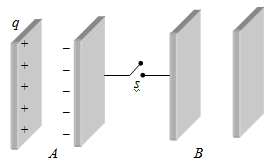
Consider the situation shown in the figure. The capacitor A has a charge q on it whereas B is uncharged. The charge appearing on the capacitor B a long time after the switch is closed is

(a) Zero

(b) q/2

(c) q

(d) 2q

A coil has an area of $0.05 m^2$ and has 800 turns. After placing the coil in a magnetic field of strength $4 \times 10^{-5} Wb / m ^2$ perpendicular to the field the coil is rotated through $90^{\circ}$ in 0.1 s . The average emf induced is __________ .

Two charged spheres of radii 10 cm and 15 cm are connected by a thin wire. No current will flow, if they have

(a) The same charge on each

(b) The same potential

(c) The same energy

(d) The same field on their surfaces

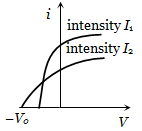
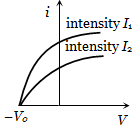
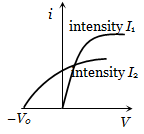
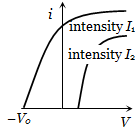
The curves (a), (b) (c) and (d) show the variation between the applied potential difference (V) and the photoelectric current (i), at two different intensities of light (I1 > I2). In which figure is the correct variation shown

 (a)

(b)

(c)

(d)

Isogonic lines on magnetic map will have

(a) Zero angle of dip

(b) Zero angle of declination

(c) Same angle of declination

(d) Same angle of dip