MCQ
An ion $M^{2+},$ forms the complexes $[M(H_2O)_6]^{2+} , [M(en)_3]^{2+}$ and $[MBr_6]^{4-},$ match the complex with the appropriate colour.
- AGreen, blue and red
- ✓Blue, red and green
- CGreen, red and blue
- DRed, blue and green
the ligand is a strong field ligand More will be the value of $\Delta_{o}$ and lower will be its wavelength. Among the given complexes the strength of ligands are $B r^{-} colours are red, green, blue the absorbed colours must be green,red,orange. Hence the compound $\left[M\left(H_{2} O\right)_{6}\right]^{2+},\left[M(e n)_{3}\right]^{2+},\left[M(B r)_{6}\right]^{4-}$ are blue red and green respectively. Hence option $B$ is correct.
Generate a complete, print-ready paper with questions like this in minutes — across 16+ boards, with answer keys.
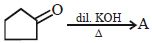
$\mathop {\begin{array}{*{20}{c}}
{\,\,\,\,\,\,\,\,\,\,\,\,\,\,O}\\
{\,\,\,\,\,\,\,\,\,\,\,\,\,\,||}\\
{CH \equiv C - C - OH}
\end{array}}\limits_{\rm{I}} $ $\mathop {\begin{array}{*{20}{c}}
{\,\,\,\,\,\,\,\,\,\,\,\,\,\,\,\,\,\,\,O}\\
{\,\,\,\,\,\,\,\,\,\,\,\,\,\,\,\,\,\,\,||}\\
{C{H_2} = CH - C - OH}
\end{array}}\limits_{{\rm{II}}} $ $\mathop {\begin{array}{*{20}{c}}
{\,\,\,\,\,\,\,\,\,\,\,\,\,\,\,\,\,\,\,O}\\
{\,\,\,\,\,\,\,\,\,\,\,\,\,\,\,\,\,\,\,||}\\
{C{H_3} - C{H_2} - C - OH}
\end{array}}\limits_{{\rm{III}}} $$\mathop {\begin{array}{*{20}{c}}
\,\,\,{C{H_3}\,\,\,\,\,\,O}\\
\,\,\,{|\,\,\,\,\,\,\,\,\,\,\,\,\,\,\,||}\\
{C{H_3} - CH - C - OH}
\end{array}}\limits_{{\rm{IV}}} $