MCQ
An ionized gas contains both positive and negative ions. If it is subjected simultaneously to an electric field along the +x direction and a magnetic field along the +z direction, then
  • A
    Positive ions deflect towards +y direction and negative ions towards –y direction
  • B
    All ions deflect towards +y direction
  • All ions deflect towards –y direction
  • D
    Positive ions deflect towards –y direction and negative ions towards +y direction
Answer

Correct option: C.
All ions deflect towards –y direction
 All ions deflect towards –y direction

Need a full question paper?

Generate a complete, print-ready paper with questions like this in minutes — across 16+ boards, with answer keys.

Start Generating Free

Similar questions

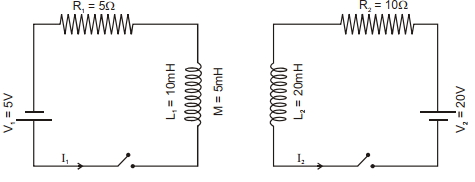
The inductors of two $L R$ circuits are placed next to each other, as shown in the figure. The values of the self-inductance of the inductors, resistances, mutual-inductance and applied voltages are specified in the given circuit. After both the switches are closed simultaneously, the total work done by the batteries against the induced $E M F$ in the inductors by the time the currents reach their steady state values is. . . . . $mJ$
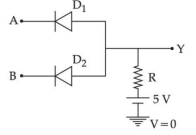
In the circuit, the logical value of $A =1$ or $B =1$ when potential at $A$ or $B$ is $5\,V$ and the logical value of $A=0$ or $B=0$ when potential at $A$ or $B$ is $0\,V$.

The truth table of the given circuit will be :

In Young's double slit experiment, if the source of light changes from orange to blue then
An electron is revolving around a proton in a circular orbit of diameter $0.1 \ nm$ . It produces a magnetic field of $14 Wb / m ^2$ at the proton. What is angular speed of the electron?
The SI unit of dipole moment is:
A galvanometer can be converted into an ammeter by connecting
The condition for obtaining secondary maxima in the diffraction pattern due to single slit is
A fully charged capacitor has a capacitance ‘C’. It is discharged through a small coil of resistance wire embedded in a thermally insulated block of specific heat capacity ‘s’ and mass ‘m’. If the temperature of the block is raised by ‘ ∆T ’, the potential difference ‘V’ across the capacitance is
Young's experiment establishes that
The device that does not work on the principle of mutual induction is