MCQ
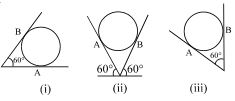
An iron sphere weighing $10\, N$ rests in a $V$ shaped smooth trough whose sides form an angle of $60^o$ as shown in the figure. Then the reaction forces are
  • A
    $R_A = 10 N$ & $R_B = 0$ in case $(i)$
  • B
    $R_A = 10 \,N$ & $R_B = 10\, N$ in case $(ii)$
  • C
    $R_A = \frac{{20}}{{\sqrt 3 }}  N$ & $R_B = \frac{{10}}{{\sqrt 3 }} N$ in case $(iii)$
  • All of the above

Answer

Correct option: D.
All of the above
d
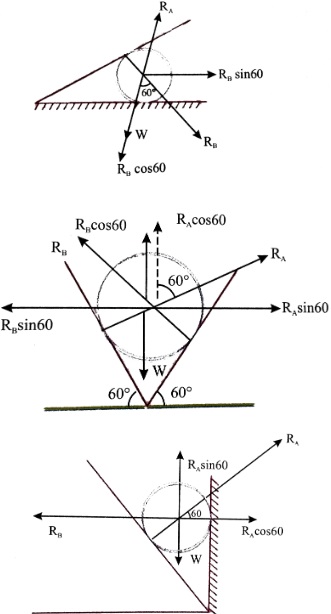
since the sphere is not moving $\sum F_{H}=0$

$R_{B} \sin 60=0$

$\therefore R_{B}=0$

$\& R_{A}=W=10 N$

$\sum F_{H}=0$

$\therefore R_{A} \sin 60=R_{B} \sin 60 \Rightarrow R_{A}=R_{B}=R$

Now $\sum F_{U}=0 \therefore 2 R \cos 60-W=0$

$R=W=10 N$

$\sum F v=0 \therefore R_{A} \sin 60=W$

$\Rightarrow R_{A}=\frac{20}{\sqrt{3}} N$ also $\sum F_{H}=0$

$R_{\frac{A}{2}}-R_{B}=0$ So $R_{B}=\frac{10}{\sqrt{3}} N$

Need a full question paper?

Generate a complete, print-ready paper with questions like this in minutes — across 16+ boards, with answer keys.

Start Generating Free

Similar questions

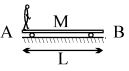
The figure shows a man of mass $m$ standing at the end $A$ of a trolley of mass $M$ placed at rest on a smooth horizontal surface. The man starts moving towards the end $B$ with a velocity $u_{rel}$ with respect to the trolley. The length of the trolley is $L$. When the man reaches the end $B$, the distance moved by the trolley with respect to ground is
The $ P.E.$ of a particle executing $SHM$ at a distance $x$ from its equilibrium position is
The upper end of a wire $1\,m$ long and $4\,mm$ radius is clamped. The lower end is twisted by an angle of $30^o$. The angle of shear is ...... $^o$
A particle is forced to move on a straight line path. It returns to the starting point after $10$ seconds. The total distance covered by the particle during this time is $20m.$ Which of the following statements is false regarding the motion of the particles?
If the rotational kinetic energy of a body is increased by $300\ \%$ then the percentage increase in its angular momentum will be .......... $\%$
The radius of a planet is $\frac{1}{4}$ of earth’s radius and its acceleration due to gravity is double that of earth’s acceleration due to gravity. How many times will the escape velocity at the planet’s surface be as compared to its value on earth’s surface
The axis of rotation of a purely rotating body:
  1. Must pass through the centre of mass.
  2. May pass through the centre of mass.
  3. Must pass through a particle of the body.
  4. May pass through a particle of the body.
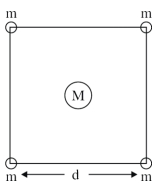
Four spheres each of mass $m$ form a square of side $d$ (as shown in figure). A fifth sphere of mass $M$ is situated at the centre of square. The total gravitational potential energy of the system is
A heavy ring of mass m is clamped on the periphery of al light circular disc. A small particle having equal mass is clamped at the centre of the disc. The system is rotated in such a way that the centre moves in a circle of radius r with a uniform speed v. We conclude that an external force:
The AC voltage across a resistance can be measured using: