MCQ
An isolated solid metallic sphere is given +Q charge. The charge will be distributed on the sphere
  •  Uniformly but only on surface
  • B
    Only on surface but non-uniformly
  • C
     Uniformly inside the volume
  • D
     Non-uniformly inside the volume

Answer

Correct option: A.
 Uniformly but only on surface
 Uniformly but only on surface

Need a full question paper?

Generate a complete, print-ready paper with questions like this in minutes — across 16+ boards, with answer keys.
Start Generating Free

Similar questions

A generator produces a voltage that is given by $V = 240\,sin \,120\,t$, where t is in seconds. The frequency and $ r.m.s.$ voltage are
A conducting rod of length $L$ is falling with velocity $V$ in a uniform horizontal magnetic field $B$ normal to the rod. The induced emf between the ends the rod will be:
In a meter bridge, the balancing length from the left end (standard resistance of one ohm is in the right gap) is found to be 20 cm. The value of the unknown resistance is
${10^{ - 3}}amp$ is flowing through a resistance of $1000\,\Omega $. To measure the correct potential difference, the voltmeter is to be used of which the resistance should be
Gauss’s law should be invalid if
Let $C_v$ and $C_p$  denote the molar heat capacities of an ideal gas at constant volume and constant pressure respectively. Which of the following is a universal constant?
Assertion : When PN-junction is forward biased then motion of charge carriers at junction is due to diffusion. In reverse biasing. The cause of motion of charge is drifting.
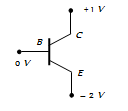
Reason : In the following circuit emitter is reverse biased and collector is forward biased.

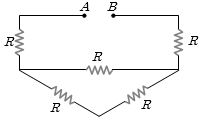
What is the equivalent resistance between $A$ and $B$ in the figure below if $R = 3\,\Omega $
A wave pulse, travelling on a two -piece string, gets partially reflected and partially transmitted at the junction. The reflected wave is inverted in shape as compared to the incident one. If the incident wave has wavelengt $\lambda$ and the transmitted wave $\lambda'.$
An electric dipole is placed along the $x - $ axis at the origin $O$. A point $P$ is at a distance of $20\,cm$ from this origin such that $OP$ makes an angle $\frac{\pi }{3}$ with the $x-$axis. If the electric field at $P$ makes an angle $\theta $ with the $x$-axis, the value of $\theta $ would be