MCQ
An NPN-transistor circuit is arranged as shown in figure. It is
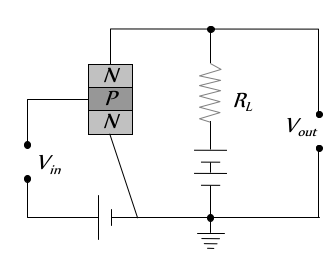
Image
  • A
    A common base amplifier circuit
  • A common emitter amplifier circuit
  • C
    A common collector amplifier circuit
  • D
    Neither of the above

Answer

Correct option: B.
A common emitter amplifier circuit
Because emitter $(M)$ is common to both, base $(P)$ and collector $(N)$.

Need a full question paper?

Generate a complete, print-ready paper with questions like this in minutes — across 16+ boards, with answer keys.

Start Generating Free

Similar questions

The average power required to lift a $100 \mathrm{~kg}$ mass through a height of $50$ metres in approximately $50$ seconds would be
A cylinder of mass $10 \mathrm{~kg}$ is sliding on a plane with an initial velocity of $10 \mathrm{~m} / \mathrm{s}$. If coefficient of friction between surface and cylinder is 0.5 , then before stopping it will describe
A cricket ball is thrown up with a speed of $19.6 ms$. The maximum height it can reach is
Which of the following loop is in stable equallibrium
Two identical straight wires are stretched so as to produce $6$ beats per second when vibrating simultaneously. On changing the tension in one of them, the beat frequency remains unchanged. Denoting by $T_1, T_2$, the higher and the lower initial tensions in the strings, then it could be said that while making the above change in tension
A body of mass $m$ is taken from earth surface to the height $h$ equal to radius of earth, the increase in potential energy will be
A small rod of bismuth is suspended freely between the poles of a strong electromagnet. It is found to arrange itself at right angles to the magnetic field. This observation establishes that bismuth is
A bomber plane moves horizontally with a speed of $500 m / s$ and a bomb released from it, strikes the ground in $10 sec$. Angle at which it strikes the ground will be $\left(g=10 m / s ^2\right)$
The length of the second pendulum on the surface of earth is $1 m$. The length of seconds pendulum on the surface of moon, where $g$ is $1 / 6$ th value of $g$ on the surface of earth, is
A thin prism $P$ with angle $4^{\circ}$ and made from glass of refractive index $1.54$ is combined with another thin prism $P$. made from glass of refractive index $1.72$ to produce dispersion without deviation. The angle of prism $P$ is