MCQ
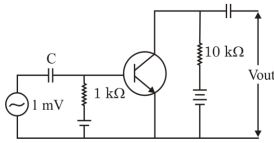
An $n.p.n$ transistor with current gain $\beta=100$ in common emitter configuration is shown in figure. The output voltage of the amplifier will be$.....V$
  • A
    $0.1$
  • $1.0$
  • C
    $10$
  • D
    $100$

Answer

Correct option: B.
$1.0$
b
$\frac{v_{\text {out }}}{v_{\text {in }}}=\beta \frac{R_{\text {out }}}{R_{\text {in }}}$

$v_{\text {out }}=\frac{100 \times 10 \times 10^{3}}{10^{3}} \times 10^{-3}$

$=1\,V$

Need a full question paper?

Generate a complete, print-ready paper with questions like this in minutes — across 16+ boards, with answer keys.
Start Generating Free

Similar questions

A surface of area $S$ is placed perpendicular to the direction of travel of a plane wave. The energy per unit time intercepted by the surface is $E$ when the amplitude of the wave is $A$ . The area of the surface is reduced to $\frac{1}{2} \ S$ and the amplitude of the wave is increased to $2\ A$ . What is the energy per unit time intercepted by this smaller surface?
A rectangular block is $5 cm × 5 cm × 10cm$  in size. The block is floating in water with $ 5 cm $ side vertical. If it floats with $10 cm $ side vertical, what change will occur in the level of water?
A force $F$ is needed to break a copper wire having radius $R.$ The force needed to break a copper wire of radius $2R$ will be
A transformer is employed to reduce $220\, V$ to $11\, V$. The primary draws a current of $5 \,A$ and the secondary $90\, A$. The efficiency of the transformer is......$\%$
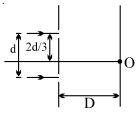
In the figure shown if a parallel beam of white light is incident on the plane of the slits if the light incident is monochromatic and point $O$ is a maxima, then the wavelength of the light incident cannot be [Assume $d < < D, \lambda < < d$]
Light is incident normally on a completely absorbing surface with an energy flux of $25\,W\,cm^{-2}.$ If the surface has an area of $25\,cm^2,$ the maximum momentum transferred to the surface in $40\,min$ time duration will be
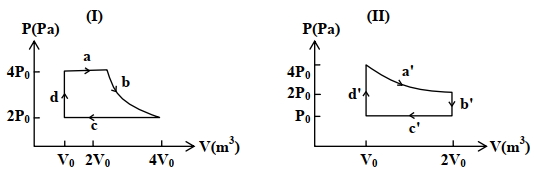
One mole of an ideal gas undergoes two different cyclic processes I and II, as shown in the $P-V$ diagrams below. In cycle I, processes $a, b, c$ and $d$ are isobaric, isothermal, isobaric and isochoric, respectively. In cycle II, processes $a^{\prime}, b^{\prime}, c^{\prime}$ and $d^{\prime}$ are isothermal, isochoric, isobaric and isochoric, respectively. The total work done during cycle I is $W_I$ and that during cycle II is $W_{I I}$. The ratio $W_I / W_{I I}$ is . . . .

(image)

Under a pressure head the rate of orderly volume flow of a liquid through a capillary tube is $Q$ . If the length of capillary tube is doubled and the diameter of tube is halved, the rate of flow would become
An $ac$ source is rated at $220V, 50 Hz.$ The time taken for voltage to change from its peak value to zero is.....$sec$
Dispersion of light is due to