Question
An object falling through a fluid is observed to have acceleration given by a = g - bv where g = gravitational acceleration and b is constant. After a long time of release, it is observed to fall with constant speed. What must be the value of constant speed?
Answer

Key concept: If a spherical body of radius r is dropped in a viscous fluid, it is first accelerated and then its acceleration becomes zero and it attains a constant velocity called terminal velocity. According to the problem, acceleration of object is given by the relation a = g - bv When speed becomes constant acceleration $\text{a}=\frac{\text{dv}}{\text{dt}}=0$ (uniform motion). where, g = gravitational acceleration Clearly, from above equation as speed increases acceleration will decrease. At a certain speed say $v_0$, acceleration will be zero and speed will remain constant. Hence, $\text{a}=\text{g}-\text{bv}_0=0$ $\Rightarrow\text{v}_0=\frac{\text{g}}{\text{b}}$

Need a full question paper?

Generate a complete, print-ready paper with questions like this in minutes — across 16+ boards, with answer keys.

Start Generating Free

Similar questions

Discuss Newton's formula for the velocity of longitudinal waves in air. What correction was applied by Laplace and why?
Explain the international system of units. Explain its characteristics.
A boy standing on a stationary lift (open from above) throws a ball upwards with the maximum initial speed he can, equal to $49m s^{–1}$. How much time does the ball take to return to his hands? If the lift starts moving up with a uniform speed of $5m s^{-1}$ and the boy again throws the ball up with the maximum speed he can, how long does the ball take to return to his hands?
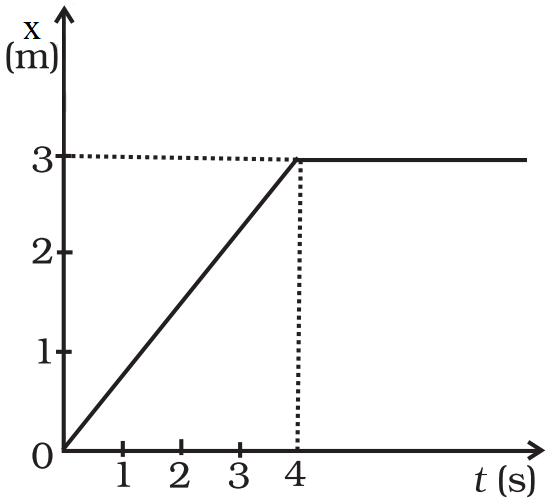
The position time graph of a body of mass $2kg$ is as given in What is the impulse on the body at $t = 0 s$ and $t = 4s$.
A small source of sound oscillates in simple harmonic motion with an amplitude of $1.7cm$. A detector is placed along the line of motion of the source. The source emits a sound of frequency $800Hz$ which travels at a speed of $340m/s$. If the width of the frequency band detected by the detector is $8Hz$, find the time period of the source.
Find the velocity of source, when the frequency appears to be (a) double (b) half, the original frequency to a stationary listener.
In a Young's double slit experiment, the separation between the slits = $2.0mm$, the wavelength of the light = $600nm$ and the distance of the screen from the slits = $2.0m$. If the intensity at the centre of the central maximum is $0.20W/ m^2$, what will be the intensity at a point $0.5cm$ away from this centre along the width of the fringes?
If the outer coil of the previous problem is rotated through 90° about a diameter, what would be the magnitude of the magnetic field B at the centre?
Suppose a tunnel is dug through the earth from one side to the other side along a diameter. Show that the motion of a particle dropped into the tunnel is simple harmonic motion. Find the time period. Neglect all the frictional forces and assume that the earth has a uniform density.
$G = 6.67 \times 10^{-11}Nm^2kg^{-2};$ density of earth = $5.51 \times 10^3kg m^{-3}$
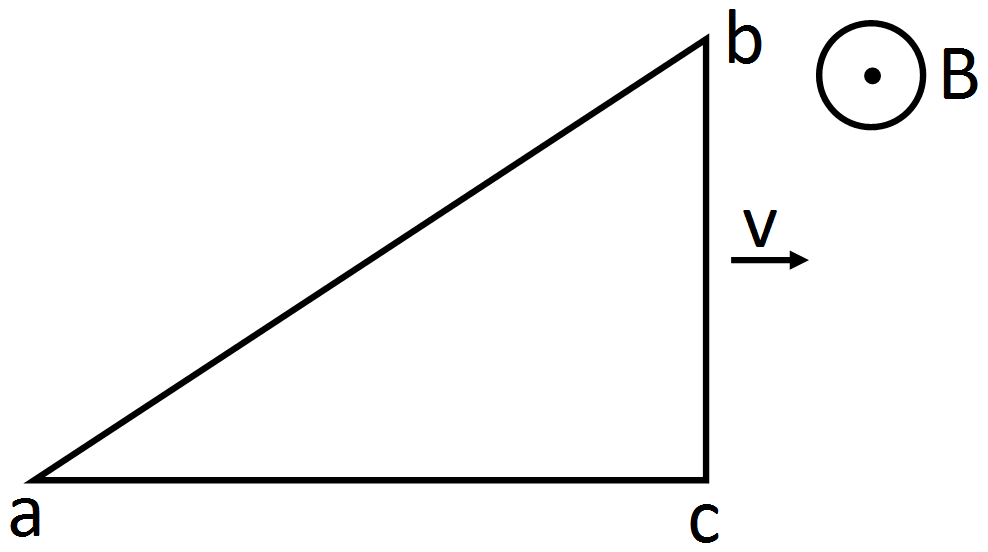
A right-angled triangle abc, made from a metallic wire, moves at a uniform speed v in its plane as shown in figure. A uniform magnetic field B exists in the perpendicular direction. Find the emf induced:
  1. In the loop abc.
  2. In the segment bc.
  3. In the segment ac.
  4. In the segment ab.