Question
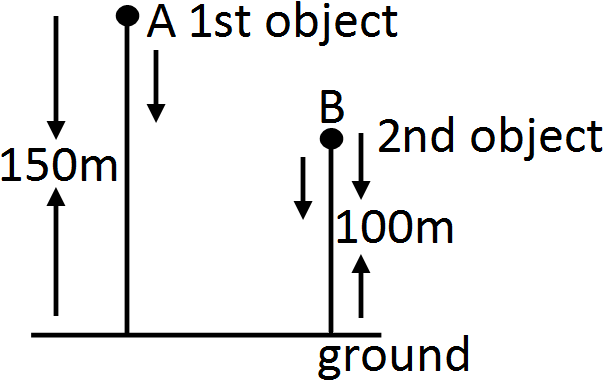
An object is dropped from rest at a height of 150m and simultaneously another object is dropped from rest at a height 100m. What is the difference in their heights after 2s if both the objects drop with same accelerations? How does the difference in heights vary with time?
Answer

For first object given, u = 0 (because object dropped from rest) and time (t) = 2s

from second equation of motion, the distance covered by first object in 2s is

$\text{h}=\text{ut}+\frac{1}{2}\text{gt}^2$

$\text{h}=0\times2+\frac{1}{2}\times10\times(2)^2\ [\because\text{g}=10\text{m/ s}^{2}]$

$\text{h}=0+\frac{1}{2}\times10\times4=20\text{m}$

Height of first object from the ground after 2s (h1) = 150m - 20m = 130m for second object guven, u = 0 and time (t) = 2s

From second equation of motion, the distance covered by second object in 2s is 

$\text{h}=\text{ut}+\frac{1}{2}\text{gt}^2=0\times2+\frac{1}{2}\times10\times(2)^2\ [\because\text{g}=10\text{m/ s}^2]$

$=0+\frac{1}{2}\times1=\times4=20\text{m}$

Height of second object from the ground after 2s then h2 = 100m – 20m = 80m Now, difference in the height after 2s = h1 – h2 = 130 – 80 = 50 m

The difference in hights of the objects will remain same with time as both the objects have been dropped from rest and are falling with same acceleration i.e (acceleration due to gravity).

Need a full question paper?

Generate a complete, print-ready paper with questions like this in minutes — across 16+ boards, with answer keys.

Start Generating Free

Similar questions

There is a water reservoir (river) near a village. Due to insufficient rain, farmers are worried about their crops. Suggest and explain the irrigation practice that can be adopted to supply water to the entire agricultural land in the village.
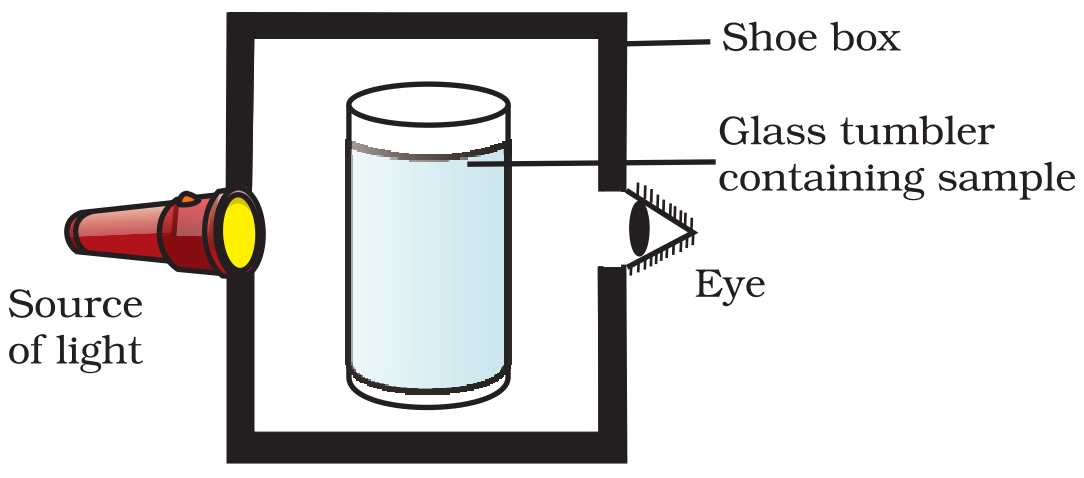
A group of students took an old shoe box and covered it with a black paper from all sides. They fixed a source of light (a torch) at one end of the box by making a hole in it and made another hole on the other side to view the light. They placed a milk sample contained in a beaker/ tumbler in the box as shown in the they were amazed to see that milk taken in the tumbler was illuminated. They tried the same activity by taking a salt solution but found that light simply passed through it?

  1. Explain why the milk sample was illuminated. Name the phenomenon involved.
  2. Same results were not observed with a salt solution. Explain.
  3. Can you suggest two more solutions which would show the same effect as shown by the milk solution?
What is the role of SER in liver cells of vertebrates?
State the law of constant proportions. Give one example to illustrate this law.
How is water purified on a large scale at water works? Explain with the help of a labelled diagram. Name the substance which is added to kill germs in the drinking water supply?
What is simple tissue? Classify and explain its Different types with suitable diagram.
Describe the structure of a nerve cell.
List five characteristics by which compounds can be distinguished from mixtures.
Describe the mechanism of crop variety improvement.

A body of 2kg falls from rest. What will be its kinetic energy during the fall at the end of 2s? (Assume g = 10m/s2)