MCQ
An object is moving with variable speed, then
  • A
    Its velocity may be zero
  • Its velocity must be variable
  • C
    Its acceleration may be zero
  • D
    Its velocity may be constant

Answer

Correct option: B.
Its velocity must be variable
b
(b)

If speed is changing then velocity must change.

Need a full question paper?

Generate a complete, print-ready paper with questions like this in minutes — across 16+ boards, with answer keys.
Start Generating Free

Similar questions

A man of mass 60kg and a boy of mass 30kg are standing together on frictionless ice surface. If they push each other apart man moves away with a speed of 0.4m/ s relative to ice. After 5sec they will be away from each other at a distance of.
The parameter that remains the same for molecules of all gases at a given temperature is :
If g is acceleration due to gravity on earth's surface, the gain in potential energy of an object of mass m raised from surface of earth to a height equal to radius R of the earth is:
A body executes sample harmonic motion under the action of a force $F_1$ with a time period $(4 / 5)\  sec$. If the force is changed to $F_ 2$ it executes $SHM$ with time period $(3 / 5)\  sec$. If both the forces $F_1$ and $F_2$ act simultaneously in the same direction on the body, it's time period (in $second$) is
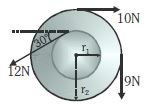
In the following figure $r_1$ and $r_2$ are $5\, cm$ and $30\, cm$ respectively. If the moment of inertia of the wheel is $5100\, kg-m^2$ then its angular acceleration will be
A given ideal gas with $\gamma  = \frac{{{C_p}}}{{{C_v}}} = 1.5$ at a temperature $T$. If the gas is compressed adiabatically to one-fourth of its initial volume, the final temperature will be ..... $T$
A gas is allowed to expand isothermally. The root mean square velocity of the molecules
The moment of inertia of a solid sphere of density $\rho $ and radius R about its diameter is
Two bodies of masses ${m_1}$ and ${m_2}$ are initially at rest at infinite distance apart. They are then allowed to move towards each other under mutual gravitational attraction. Their relative velocity of approach at a separation distance $r$ between them is
Of the following the one which emits sound of higher pitch is