MCQ
An object is placed at a distance u from a simple microscope of focal length f. The angular magnification obtained depends:
- AOn f but not on u.
- BOn u but not on f.
- COn f as well as u.
- DNeither on f nor on u.
An object is placed at a distance u from a simple microscope of focal length f. The angular magnification obtained depends:
On f as well as u.
Explanation:
The angular magnification is the ratio of the angle subtended by the image to the angle subtended by the object on an unaided eye.
In a simple microscope,
$\text{m}=\frac{\frac{\text{h}}{\text{x}}}{\frac{\text{h}}{\text{D}}}$
Here,
u = Object distance from the lems
D = Image distance form the lens
h = Height of the object
In normal adjustment, the object is placed at a distance equal to focal length (f) from the lens and then magnification is given by m
$=\frac{\text{D}}{\text{f}}$
for $\text{u}<\text{f},\text{ m}=\frac{\text{D}}{\text{f}}+1$
Generate a complete, print-ready paper with questions like this in minutes — across 16+ boards, with answer keys.
In Young’s experiment, the ratio of maximum to minimum intensities of the fringe system is 4 : 1. The amplitudes of the coherent sources are in the ratio
|
(a) 4 : 1 |
(b) 3 : 1 |
(c) 2 : 1 |
(d) 1 : 1 |
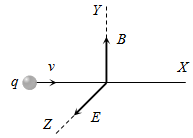
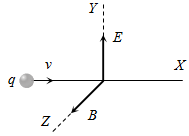
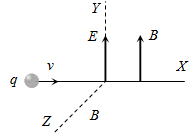
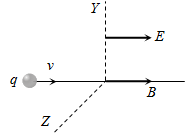
A particle of charge q and mass m is moving along the x -axis with a velocity v and enters a region of electric field E and magnetic field B as shown in figure below for which figure the net force on the charge may be zero
|
(a)
|
(b)
|
(c)
|
(d)
|
Which of the following are suitable for the fusion process
|
(a) Heavy nuclei |
(b) Light nuclei |
(c) Atom bomb |
(d) Radioactive decay |
The unit of electric permittivity is
|
(a) Volt/m2 |
(b) Joule/coulomb |
(c) Farad/m |
(d) Henry/m |
Frequency of a wave is 6  . The wave is
|
(a) Radiowave |
(b) Microwave |
(c) X-ray |
(d) None of these |