MCQ
An object is placed at a distance u from a simple microscope of focal length $f$. The angular magnification obtained depends:
- AOn $f$ but not on $u.$
- BOn $u$ but not on $f.$
- ✓On $f$ as well as $u.$
- DNeither on $f$ nor on $u.$
The angular magnification is the ratio of the angle subtended by the image to the angle subtended by the object on an unaided eye.
In a simple microscope,
$\text{m}=\frac{\frac{\text{h}}{\text{x}}}{\frac{\text{h}}{\text{D}}}$
Here,
$u =$ Object distance from the lems
$D =$ Image distance form the lens
$h =$ Height of the object
In normal adjustment, the object is placed at a distance equal to focal length $(f)$ from the lens and then magnification is given by m
$=\frac{\text{D}}{\text{f}}$
for $\text{u}<\text{f},\text{ m}=\frac{\text{D}}{\text{f}}+1$
Generate a complete, print-ready paper with questions like this in minutes — across 16+ boards, with answer keys.
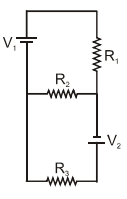
The current in resistance $R _2$ would be zero if
$(A)$ $V_1=V_2$ and $R_1=R_2=R_3$
$(B)$ $V_1=V_2$ and $R_1=2 R_2=R_3$
$(C)$ $V_1=2 V_2$ and $2 R_1=2 R_2=R_3$
$(D)$ $2 V _1= V _2$ and $2 R _1= R _2= R _3$