Question
An object is thrown vertically upwards. After some time it returns to earth. Draw the speed time graph for the ball. (Note: Consider the air borne resistance as negligible here.)
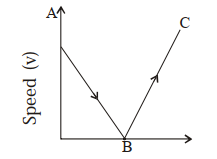
Image

Answer

When an object is thrown upward it is thrown by giving intial velocity. On going up the velocity decreases and at the highest point the velocity becomes zero. After this the ball comes down and the velocity increases.

Need a full question paper?

Generate a complete, print-ready paper with questions like this in minutes — across 16+ boards, with answer keys.

Start Generating Free

Similar questions

Two bodies are thrown with same velocities at angles $\alpha$ and $(90^\circ-\alpha)$ with the horizontal. What will be the ratio of $(i)$ maximum heights attained by them $(ii)$ their horizontal ranges?
A 100W bulb together with its power supply is suspended from a sensitive balance. Find the change in the mass recorded after the bulb remains on for 1 year.
Show that $\vec{\text{a}}.(\vec{\text{b}}\times\vec{\text{c}})$ is equal in magnitude to the volume of a parallelopiped formed by the three vectors $\vec{\text{a}},\vec{\text{b}}$ and $\vec{\text{c}}.$
The outer surface of a cylinder containing a gas is rubbed vigorously by a polishing machine. The cylinder and its gas become warm. Is the energy transferred to the gas heat or work?
Give the salient features of Einstein's theory.
A spring weighing machine inside a stationary lift reads $10\ kg,$ when a man stands on it. What would happen to the scale reading, if the lift is moving upward with $(i)$ constant velocity and $(ii)$ constant acceleration?
Given the moment of inertia of a disc of mass M and R radius R about any of its diameters to be $\frac{\text{MR}^2}{4},$ find its moment of inertia about an axis normal to the disc and passing through a point on its rim.
A planet moving around the sun is a good illustration of the law of conservation of energy. Explain.
Just as precise measurements are necessary in science, it is equally important to be able to make rough estimates of quantities using rudimentary ideas and common observations. Think of ways by which you can estimate the following (where an estimate is difficult to obtain, try to get an upper bound on the quantity): The wind speed during a storm.
A simple microscope is rated 5 for a normal relaxed eye. What will be its magnifying power for a relaxed farsighted eye whose near point is 40cm?