Question
An object may be regarded to be at rest or in motion depending on the frame of reference chosen to view the object. Because of length contraction it would mean that the same rod may have two different lengths depending on the state of the observer. Is this true?
Answer

Yes, it is true. If a rod is moving at a certain speed v, its contracted length is given as $\text{l}=\text{l}_0\sqrt{1-\frac{\text{v}^2}{\text{c}^2}},\text{v}<\text{c}$ where $\text{l}_0$ is the length of the rod at rest, i.e. the length varies when measured from different frames. If the observer and the rod are moving with the same speed v in the same direction, then length of the rod l is equal to $\text{l}_0$, Also, if they are moving ​with the same speed v in the opposite direction, the measured length of the rod measured is given by:$\text{l}=\text{l}_0\sqrt{1-\frac{(\text{v}-(-\text{v})^2}{\text{c}^2}}=\text{l}_0\sqrt{1-\frac{4\text{v}^2}{\text{c}^2}}$

Need a full question paper?

Generate a complete, print-ready paper with questions like this in minutes — across 16+ boards, with answer keys.

Start Generating Free

Similar questions

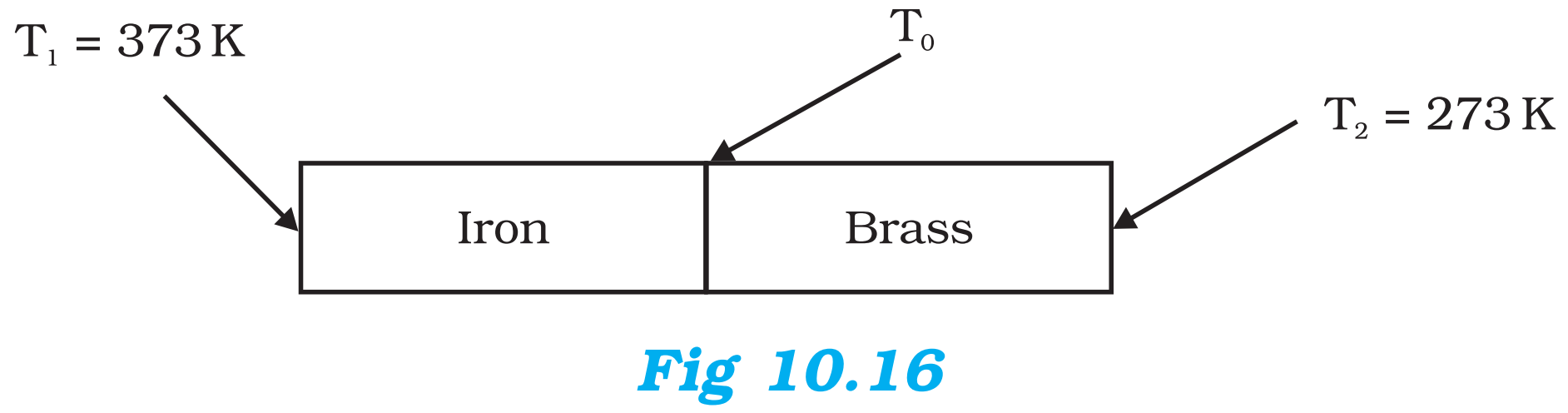
An iron bar $\left(L_1=0.1 m , A_1=\right. \left.0.02 m ^2, K_1=79 W m ^{-1} K ^{-1}\right)$ and a brass bar $\left(L_2=0.1 m , A_2=0.02 m ^2\right.$, $K_2=109 W m ^{-1} K ^{-1}$ ) are soldered end to end as shown in Fig. $10.16.$ The free ends of the iron bar and brass bar are maintained at $373 K$ and $273 K$ respectively. Obtain expressions for and hence compute $(i)$ the temperature of the junction of the two bars, $(ii)$ the equivalent thermal conductivity of the compound bar, and $(iii)$ the heat current through the compound bar.
Image
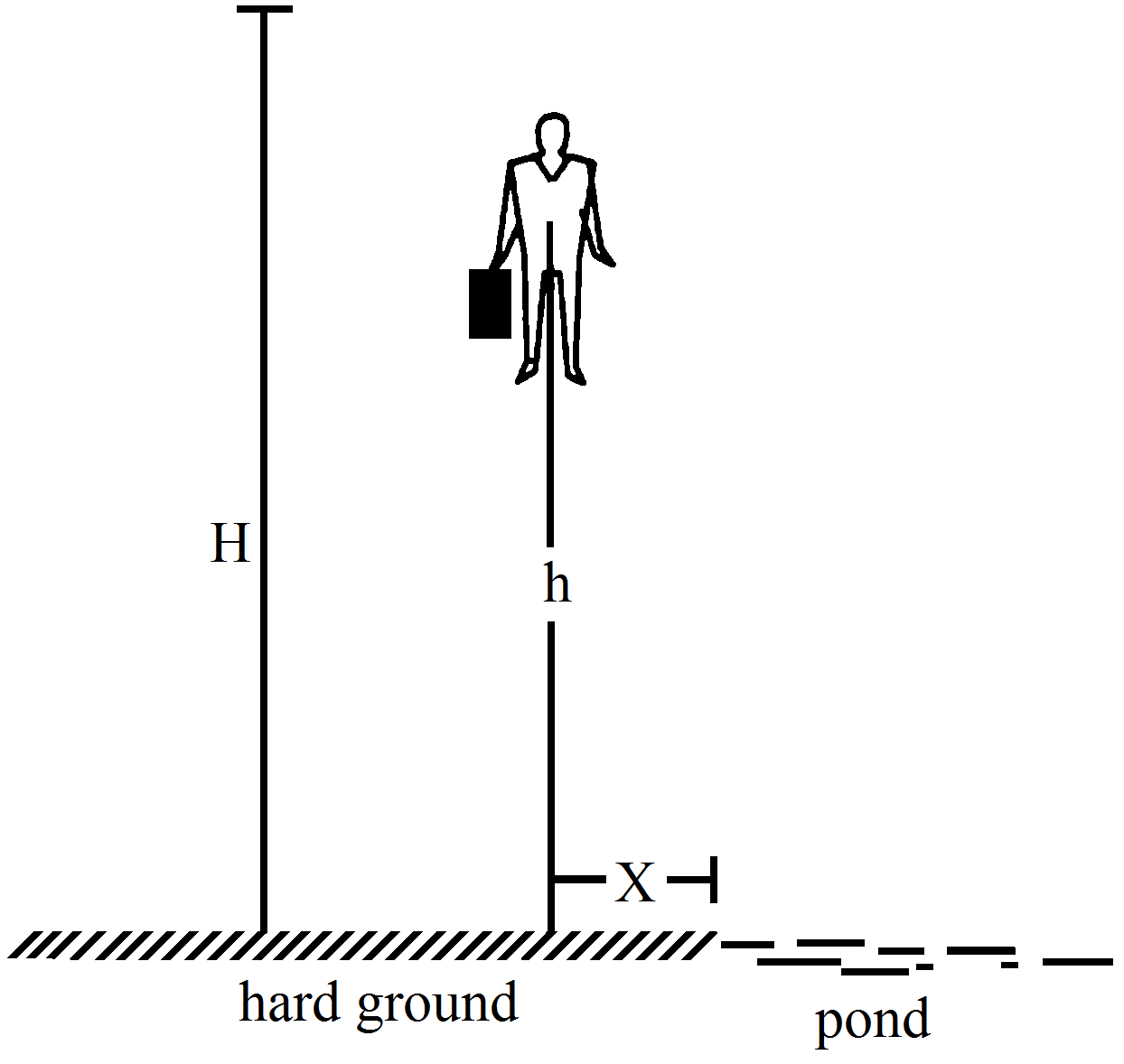
A man of mass M having a bag of mass m slips from the roof of a tall building of height H and starts falling vertically. When at a height h from the ground, he notices that the ground below him is pretty hard, but there is a pond at a horizontal distance x from the line of fall. In order to save himself he throws the bag horizontally (with respect to himself) in the direction opposite to the pond. Calculate the minimum horizontal velocity imparted to the bag so that the man lands in the water. If the man just succeeds to avoid the hard ground, where will the bag land?
A solid disc and a ring, both of radius $10cm$ are placed on a horizontal table simultaneously, with initial angular speed equal to $10 π$ rad $s^{-1}$. Which of the two will start to roll earlier? The co-efficient of kinetic friction is $\mu_\text{k}=0.2$
Find the total heat produced in the loop of the previous problem during the interval $0$ to $30s$ if the resistance of the loop is $4.5\text{m}\Omega.$
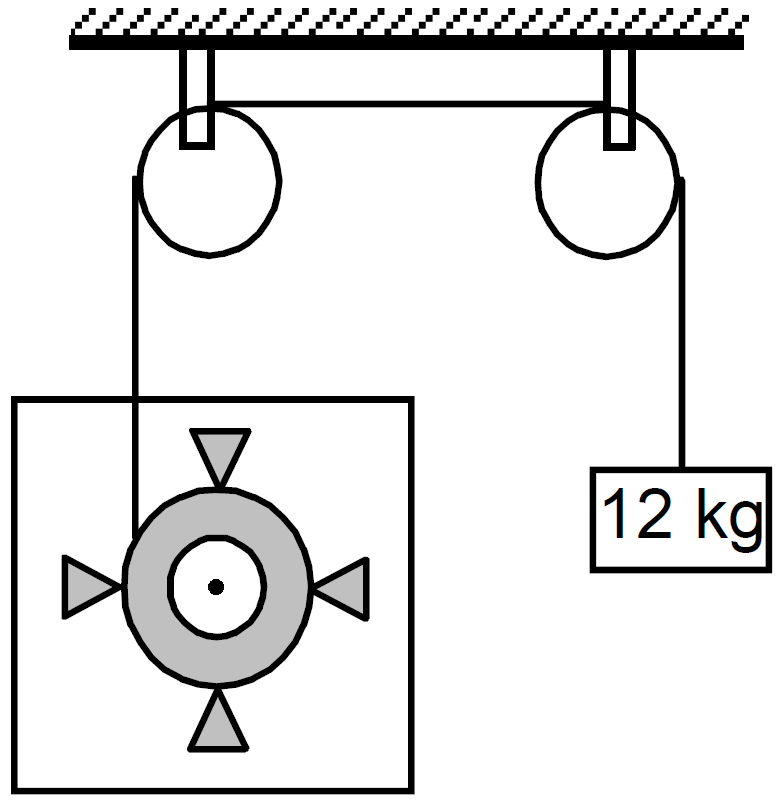
Figure. shows a paddle wheel coupled to a mass of $12kg$ through fixed frictionless pulleys. The paddle is immersed in a liquid of heat capacity $4200JK^{-1}$ kept in an adiabatic container. Consider a time interval in which the $12kg$ block falls slowly through $70cm$.
  1. How much heat is given to the liquid?
  2. How much work is done on the liquid?
  3. Calculate the rise in the temperature of the liquid neglecting the heat capacity of the container and the paddle.
The free surface of oil in a tanker, at rest, is horizontal. If the tanker starts accelerating the free surface will be titled by an angle $\theta.$ If the acceleration is a m $s^{-2}$, what will be the slope of the free surface?
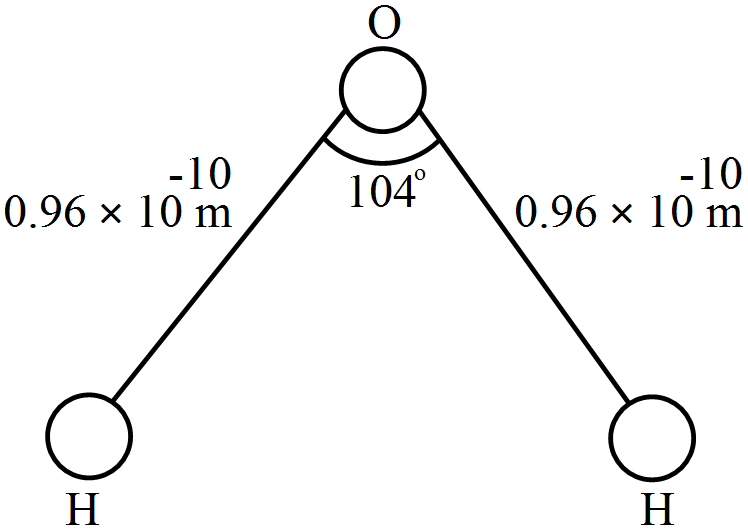
The structure of a water molecule is shown in figure. Find the distance of the centre of mass of the molecule from the centre of the oxygen atom.
In changing the state of a gas adiabatically from an equilibrium state A to another equilibrium state B, an amount of work equal to 22.3J is done on the system. If the gas is taken from state A to B via a process in which the net heat absorbed by the system is 9.35 cal, how much is the net work done by the system in the latter case? (Take 1 cal = 4.19J)
It is required to find the volume of a rectangular block. A Vernier Caliper is used to measure the length, width and height of the block. The measured values are found to be 1.37cm, 4.11cm and 2.56cm respectively.
An oxygen cylinder of volume 30 litres has an initial gauge pressure of 15 atm and a temperature of 27°C. After some oxygen is withdrawn from the cylinder, the gauge pressure drops to 11 atm and its temperature drops to 17°C. Estimate the mass of oxygen taken out of the cylinder $(R = 8.31J\ mol^{-1}K^{-1},$ molecular mass of $O_2 = 32u).$