MCQ
An object may have:
  • A
    Varying speed without having varying velocity.
  • B
    Varying velocity without having varying speed.
  • C
    Nonzero acceleration without having varying speed.
  • $B$ and $C$

Answer

Correct option: D.
$B$ and $C$
Velocity and acceleration are vector quantities that can be changed by changing direction only $($keeping magnitude constant$).$

Need a full question paper?

Generate a complete, print-ready paper with questions like this in minutes — across 16+ boards, with answer keys.
Start Generating Free

Similar questions

The position vector of a particle $\vec R$ as a function of time is given by $\overrightarrow {\;R} = 4\sin \left( {2\pi t} \right)\hat i + 4\cos \left( {2\pi t} \right)\hat j$ where $R$ is in meters, $t$ is in seconds and  $\hat i$ and $\hat j$  denote unit vectors along $x-$ and $y-$directions, respectively. Which one of the following statements is wrong for the motion of particle? 
The quantity of radiation emitted by a surface per second depends upon :
Two simple pendulums of length $5m$ and $10m$ respectively are given small linear displacement in one direction at the same time. They will be again in the phase when the pendulum of shorter length has completed oscillations:
A cyclindrical vessel of cross-sectional area $1000$ $cm^2$, is fitted with a frictionless piston of mass $10$ $kg$, and filled with water completely.A small hole of cross-sectional area $10$ $mm^2$ is opened at a point $50$ $cm$ deep from the lower surface of the piston. The velocity of efflux from the hole will be ........... $m/s$
When a spiral spring is stretched by suspending a load on it, the strain produced is called
If the Earth has no rotational motion, the weight of a person on the equator is $W$. Determine the speed with which the earth would have to rotate about its axis so that the person at the equator will weight $\frac{3}{4}\,W$ . Radius of the Earth is $6400\, km$ and $g = 10\, m/s^2$
A person walks $25.0^{\circ}$ north of east for $3.18 \,km$. How far would she have to walk due north and then due east to arrive at the same location?
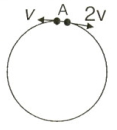
Two small particles of equal masses start moving in opposite directions from a point $A$ in a horizontal circular orbit. Their tangential velocities are $v$ and $2 v$, respectively, as shown in the figure. Between collisions, the particles move with constant speeds. After making how many elastic collisions, other than that at $A$, these two particles will again reach the point $A$ ?
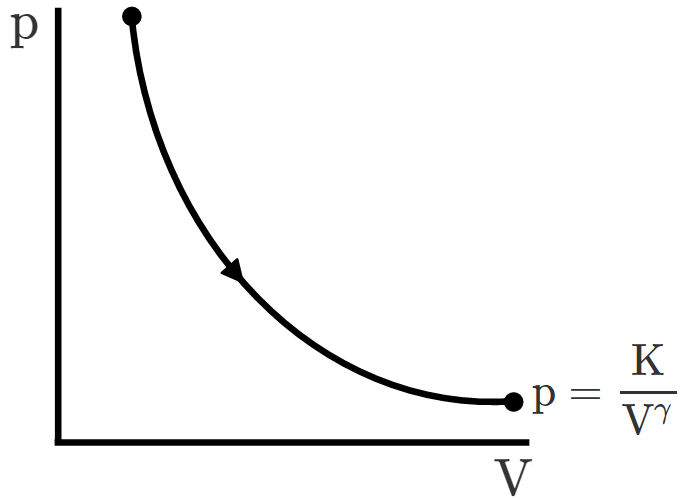
The molar heat capacity for the process shown in the figure is:
A man standing on a road hold his umbrella at $30^° $ with the vertical to keep the rain away. He throws the umbrella and starts running at $10\, km/hr$. He finds that raindrops are hitting his head vertically, the speed of raindrops with respect to the road will be......... $km/hr$