An object of mass $m$ is suspended at the end of a massless wire of length $L$ and area of cross$-$section, $A$. Young modulus of the material of the wire is $Y$. If the mass is pulled down slightly its frequency of oscillation along the vertical direction is
JEE MAIN 2020, Medium


Download our appand get started for free
Experience the future of education. Simply download our apps or reach out to us for more information. Let's shape the future of learning together!No signup needed.*
Similar Questions
- 1In forced oscillation of a particle the amplitude is maximum for a frequency $\omega_{1}$ of the force, while the energy is maximum for a frequency $\omega_{2}$ of the force, thenView Solution
- 2A loaded vertical spring executes $S.H.M.$ with a time period of $4\; sec$. The difference between the kinetic energy and potential energy of this system varies with a period of ........$sec$View Solution
- 3A $0.10\, kg$ block oscillates back and forth along a horizontal surface. Its displacement from the origin is given by: $x = (10\,cm)\cos [(10\,rad/s)\,t + \pi /2\,rad]$. What is the maximum acceleration experienced by the blockView Solution
- 4View SolutionThe equation of simple harmonic motion may not be expressed as (each term has its usual meaning)
- 5View SolutionA particle is moving in a circle with uniform speed. Its motion is
- 6A particle executes simple hormonic motion between $x =\, -A$ and $x = +A$ . It starts from $x = 0$ moves in $+x-$ direction. The time taken for it to move from $x = 0$ to $x = \frac {A}{2}$ is $T_1$ and to move from $\frac {A}{2}$ to $\frac {A}{\sqrt 2}$ is $T_2$ , thenView Solution
- 7Two masses $M_{A}$ and $M_{B}$ are hung from two strings of length $l_{A}$ and $l_{B}$ respectively. They are executing SHM with frequency relation $f_{A}=2 f_{B}$, then relationView Solution
- 8A particle is executing simple harmonic motion $(SHM)$ of amplitude $A,$ along the $x-$ axis, about $x = 0.$ When its potential energy $(PE)$ equals kinetic energy $(KE),$ the position of the particle will beView Solution
- 9The springs shown are identical. When $A = 4kg$, the elongation of spring is $1\, cm$. If $B = 6\,kg$, the elongation produced by it is ..... $ cm$View Solution
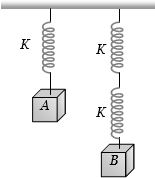
- 10The displacement of a particle executing SHM is given by $x=10 \sin \left(\omega t+\frac{\pi}{3}\right) \mathrm{m}$. The time period of motion is $3.14 \mathrm{~s}$. The velocity of the particle at $\mathrm{t}=0$is_________. $\mathrm{m} / \mathrm{s}$.View Solution