Question
An object placed in one medium when seen from the other medium, appears to be vertically shifted. Name two factors on which the magnitude of shift depends and state how does it depend on them.

Answer

The factors on which the magnitude of shift depends are:
(a) The refractive index of the medium,
(b) The thickness of the denser medium and
(c) The colour (or wavelength) of incident light.
The shift increase with the increase in the refractive index of medium. It also increases with the increase in thickness of denser medium but the shift decreases with the increases in the wavelength of light used.

Need a full question paper?

Generate a complete, print-ready paper with questions like this in minutes — across 16+ boards, with answer keys.
Start Generating Free

Similar questions

Two resistors P and Q of the same material and length but of different thickness are connected in parallel to a battery. The cross- sectional area of P is twice that of Q. What is the ratio of
(a) The resistance of P to the resistance of Q?
(b) The current in P to the current in Q?
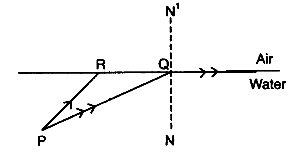
PQ and PR are two light rays emerging from the object as shown in the figure below:

(i) What is the special name given to the angle of incidence (∠PQN) of ray PQ?
(ii) Copy the ray diagram and complete it to show the position of the image of the object P when seen obliquely from above.
(iii) Name the phenomenon that occurs if the angle of incidence ∠PQN is increased still further.
A piece of copper of mass 1 kg is dropped into 2 kg of water at 15°C. If the final temperature of the mixture is 40°C, calculate the intial temperature of copper.
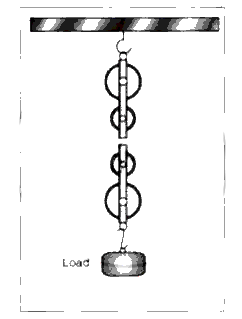
Fig show a system of four pulleys. The upper two pulleys are fixed and the lower two are movable.


(i) Draw a string around the pulleys. Also show the place and direction in which the effort is applied.
(ii) What is the velocity ratio of the system?
(iii) What is the mechanical advantage of the system?
(iv) What assumption do you make in arriving at your answer in part (iii)?
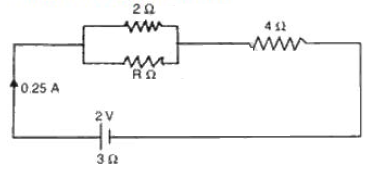
The circuit diagram (Fig .) shows three resistors 2 Ω, 4 Ω and RΩ connected to a battery of e.m.f. 2 V and internal resistance 3 Ω. A main current of 0 .25
A flows through the circuit.

Image

(i ) What is the p.d . across the 4 Ω resistor?
(ii ) Calculate the p.d . across the in ternal resistance of the cell.
(iii ) What is the p.d . across the R Ω or 2 Ω resistors?
(iv) Calculate the value of R.

Waves produced on the surface of the water are formed to move with a velocity of $24 ms^{−1}$​​​​​​​. If the wavelength of these waves equals $20 \ cm$. find the
(i) frequency (no. of waves produced per second)
(ii) the time period (i.e. the time required to produce one wave) for these waves.
At what position a candle of length 3 cm be placed in front of a convex lens so that its image of length 6 cm be obtained on a screen placed at distance 30 cm behind the lens?
What is the focal length of lens in part (a)?
Name and state the law which determines the direction of induced current.

or

State Fleming’s right-hand rule.

A particular resistance wire has a resistance of 3 ohm per meter. Find :

The total resistance of three lengths of this wire each 1.5 m long, in parallel.

Show by a ray diagram that a diverging lens cannot form a real image of an object placed anywhere on its principal axis.