MCQ
An object while moving may not have:
  • A
    Variable speed but constant velocity.
  • B
    Variable velocity but constant speed.
  • C
    Non-zero acceleration but constant speed.
  • D
    Zero acceleration but constant velocity.

Answer

  1. Variable speed but constant velocity.

Need a full question paper?

Generate a complete, print-ready paper with questions like this in minutes — across 16+ boards, with answer keys.
Start Generating Free

Similar questions

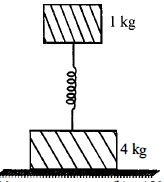
Two bodies of masses $1\, kg$ and $4\, kg$ are connected to a vertical spring, as shown in the figure. The smaller mass executes simple harmonic motion of angular frequency $25\, rad/s$, and amplitude $1.6\, cm$ while the bigger mass remains stationary on the ground. The maximum force exerted by the system on the floor is ..... $N$ ( take $g = 10\, ms^{-2}$)
If for two vectors $\overrightarrow A $ and $\overrightarrow B ,\overrightarrow A \times \overrightarrow B = 0,$ the vectors
A cube has a side of length $1.2 \times 10^{-2}\; m$. Calculate its volume.
Aplanet of mass $m$ is in an elliptical orbit about the sun $(m < < M_{sun})$ with an orbital period $T.$ If $A$ be the area of orbit, then its angular momentum would be :
The free end of a simple pendulum is attached to the ceiling of a box. The box is taken to a height and the pendulum is oscillated. When the bob is at its lowest point, the box is released to fall freely. As seen from the box during this period, the bob will:
  1. Continue its oscillation as before.
  2. Stop.
  3. Will go in a circular path.
  4. Move on a straight line.
Two equal forces ($P$ each) act at a point inclined to each other at an angle of $120^°$. The magnitude of their resultant is
A particle of mass $10\, gm$ moves in a field where potential energy per unit mas is given by expression $v = 8 \times 10^4\, x^2\, erg/gm$. If the total energy of the particle is $8 \times 10^7\, erg$ then the relation between $x$ and time $t$ is
A liquid does not wet the solid surface if angle of contact is
If $x, v$ and $a$ denote the displacement, the velocity and the acceleration of a particle executing simple harmonic motion of time period $T$, then, which of the following does not change with time?
Efficiency $(\eta)$ of the heat engine in thermodynamics can be defined as: