MCQ
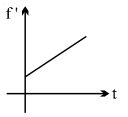
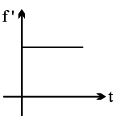
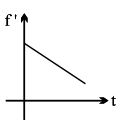
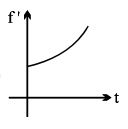
An observer starts moving with uniform acceleration $'a'$ towards a stationary sound source of frequency $f.$ As the observer approaches the source, the apparent frequency $f'$ heard by the observer varies with time $t$ as:

  • B

  • C

  • D

Answer

Correct option: A.

a
For observer approaching a stationary source

$n^{\prime}=\frac{v+v_{0}}{v} n$ and given $v_{0}=a t \Rightarrow n^{\prime}=\left(\frac{a n}{v}\right) t+n$ This is the equation

of straight line with positive intercept $n$ and positive slope $\left(\frac{n}{v}\right)$

Need a full question paper?

Generate a complete, print-ready paper with questions like this in minutes — across 16+ boards, with answer keys.

Start Generating Free

Similar questions

An electron with kinetic energy $5eV$ is incident on a hydrogen atom in its ground state. The collision:
The displacements of two particles executing $S.H.M.$ on the same line are given. as $y_1=a \sin \left(\frac{\pi}{2} t+\phi\right)$ and $y_2=b \sin \left(\frac{2 \pi}{3} t+\phi\right)$. The phase difference between them at $t=1 \,s$ is .........
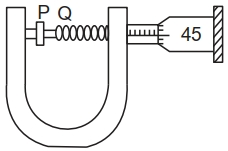
In an experiment to find out the diameter of wire using screw gauge, the following observation were noted.

$(a)$ Screw moves $0.5\,mm$ on main scale in one complete rotation

$(b)$ Total divisions on circular scale $=50$

$(c)$ Main scale reading is $2.5\,mm$

$(d)$ $45^{\text {th }}$ division of circular scale is in the pitch line

$(e)$ Instrument has $0.03 \;mm$ negative error

Then the diameter of wire is $...........\,mm$
The resultant of $\overrightarrow{\text{A}}$ and $\overrightarrow{\text{B}}$ makes an angle a with $\overrightarrow{\text{A}}$ and $\beta$ with $\overrightarrow{\text{B}},$
Two men, of masses $60\, kg$ and $80\, kg$ are sitting at the ends of $a$ boat of mass $60\, kg$ and length $4\, m$. The boat is stationary. If the men now exchange their positions, then
An electric kettle (rated accurately at $2.5\, kW$) is used to heat $3\, kg$ of water from $15\,^oC$ to boiling point. It takes $9.5$ minute. Then, the amount of heat that has been lost is
At what height from the ground will the value of $‘g’ $ be the same as that in $10 \,km$ deep mine below the surface of earth ......... $km$
The escape velocities of two planets $A$ and $B$ are in the ratio $1: 2$. If the ratio of their radii respectively is $1: 3$, then the ratio of acceleration due to gravity of planet $A$ to the acceleration of gravity of planet $B$ will be:
If momentum $(P),$ area $(A)$ and time $(T)$ are taken to be fundamental quantities, then energy has the dimensional formula:
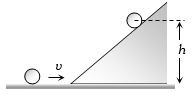
A disc of mass $M$ and radius $R$ rolls in a horizontal surface and then rolls up an inclined plane as shown in the fig. If the velocity of the disc is $v$, the height to which the disc will rise will be..