MCQ
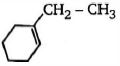
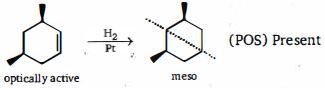
An optically active compound $A$ with molecular formula $C_8H_{14}$ undergoes catalytic hydrogenation to give mesa compound, the structure of $(A)$ is
- A
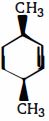
- ✓
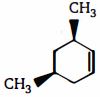
- C

- D
Generate a complete, print-ready paper with questions like this in minutes — across 16+ boards, with answer keys.
${C_6}{H_6}\left( \ell \right) + \frac{{15}}{2}{O_2} \to 6C{O_2}\left( g \right) + 3{H_2}O\left( \ell \right)\,\,\,\,\Delta H = - 3271\,kJ$
What is the value of $\Delta U$ for combustion of $1.5\, mol$ benzene at $27\,^oC$ ? .....$kJ$
The half-life period is independent of the concentration of zinc at constant $pH$. For the constant concentration of $Zn$, the rate becomes $100$ times when $pH$ is decreased from $3\, to\, 2$. Identify the correct statements $(pH = -\log [H^{+}])$
$(A)$ $\frac{{dx}}{{dt}}\, = k{[Zn]^0}{[{H^ + }]^2}$
$(B)$ $\frac{{dx}}{{dt}}\, = k{[Zn]}{[{H^ + }]^2}$
$(C)$ Rate is not affected if the concentraton of zinc is made four times and that of $H^+$ ion is halved.
$(D)$ Rate becomes four times if the concentration of $H^+$ ion is doubled at constant $Zn$ concentration
Reaction $- (2): CH_3 -CH = CH -CH_3 \xrightarrow{KMn{{O}_{4}}/NaI{{O}_{4}}}(C)$ $2\,mole$
Product $(B)$ and $(C)$ respectively are