MCQ
An optically active compound
  • Rotates the plane polarised light
  • B
    Changing the direction of polarised light
  • C
    Do not allow plane polarised light to pass through
  • D
    None of the above

Answer

Correct option: A.
Rotates the plane polarised light
a
(a)When the plane-polarised light passes through certain substance, the plane of polarisation of the light is rotated about the direction of propagation of light through a certain angle.

Need a full question paper?

Generate a complete, print-ready paper with questions like this in minutes — across 16+ boards, with answer keys.
Start Generating Free

Similar questions

The refracting angle of prism is $60^o$ and the index of refraction is $\sqrt{7/3}$ relative to surrounding. The limiting angle of incidence of a ray that the will be transmitted through the prism is ......$^o$
The wavelength associated with an electron accelerated through a potential difference of $100 V$ is nearly .............. $\mathop {\rm{A}}\limits^o $
A particle of mass $m$ and charge $q$ is thrown from origin at $t = 0$ with velocity $2\hat{i}$ + $3\hat{j}$ + $4\hat{k}$ units in a region with uniform magnetic field $\vec B$ = $2\hat{i}$ units. After time $t =\frac{{\pi m}}{{qB}}$ , an electric field  is switched on such that particle moves on a straight line with constant speed. $\vec E$ may be
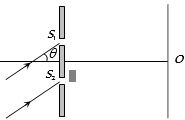
A monochromatic beam of light falls on YDSE apparatus at some angle (say $\theta$) as shown in figure. A thin sheet of glass is inserted in front of the lower slit $S_2$. The central bright fringe (path difference $= 0$) will be obtained
A telegraph line of length $100 \,km$ has a capacity of $0.01\,\mu F / km$ and it carries an alternating current at $0.5 \,kilo \,cycle \,per \,second$. If minimum impedance is required, then the value of the inductance that needs to be introduced in series is__________ $m H$. $\text { (if } \pi=\sqrt{10})$
The incident ray, reflected ray and the outward drawn normal are denoted by the unit vectors $\overrightarrow{ a }, \overrightarrow{ b }$ and $\overrightarrow{ c }$ respectively. Then choose the correct relation for these vectors.
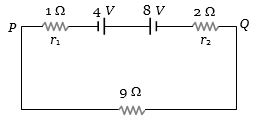
Two batteries of $e.m.f.$ $4\,V$ and $8 \,V$ with internal resistances $1\, \Omega$ and $2\,\Omega$ are connected in a circuit with a resistance of $9 \,\Omega$ as shown in figure. The current and potential difference between the points $P$ and $Q$ are
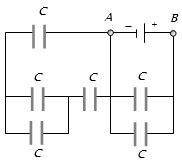
Find equivalent capacitance between $A$ and $B$......$C$
16 gm sample of a radioactive element is taken from Bombay to Delhi in 2 hour and it was found that 1 gm of the element remained (undisintegrated). Half life of the element is
Two equal negative charges $-\, q$ each are fixed at the points $(0, a)$ and $(0, -a)$ on the $Y$ -axis. A positive charge $Q$ is released from rest at the point $(2a, 0)$ on the $X$ -axis. The charge $Q$ will :-