Question
An organic compound $'A\ ' ($molecular formula $C_3H_6O)$ is resistant to oxidation but forms a compound $'B\ ' (C_3H_8O)$ on reduction. $'B\ '$ reacts with $HBr$ to form a bromide $'C\ '$ which on treatment with alcoholic $KOH$ forms an alkene $'D\ ' (C_3H_6).$ Deduce the structures of $A, B, C$ and $D.$
Answer

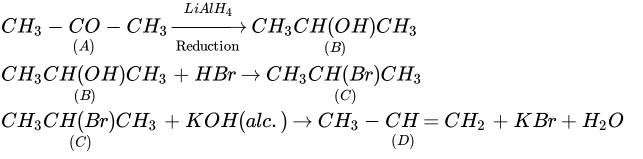
Structure of $A, B, C$ and $D$ are deduced in the following manner.
Image

Need a full question paper?

Generate a complete, print-ready paper with questions like this in minutes — across 16+ boards, with answer keys.

Start Generating Free

Similar questions

What is meant by positive deviations from Raoult's law? Give an example. What is the sign of $\triangle _{\text{mix}}\text{H}$ for positive deviation?
Methylamine is more basic than aniline. Give reason.
Explain the following :
(a) Transition elements show variable oxidation states.
(b) The paramagnetic character in $3 d$ transition series elements increases upto Mn and then decreases.
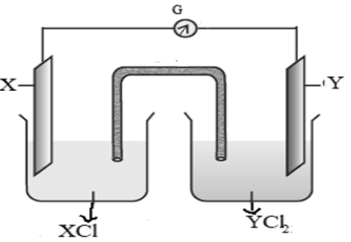
Observe the following cell and answer the questions that follow:
Image
a. Represent the cell shown in the figure.
b. Name the carriers of the current in the salt bridge
c. Write the reaction taking place at the anode.
Calculate the osmotic pressure in pascals exerted by a solution prepared by dissolving 1.0 g of polymer of molar mass 185,000 in 450 mL of water at 37°C.
Calculate the mass percentage of aspirin $(C_9H_8O_4)$ in acetonitrile $(CH_3CN)$ when $6.5 g$ of $C_9H_8O_4$ is dissolved in $450 g$ of $CH_3CN.$
Compound (A) is formed when aniline is treated with $NaNO _2+ HCl$ at 273-278 K. Compound (B) is formed when cuprous chloride is added to (A).
Write the name of compound (A) and (B) and the equations of the chemical reactions involved.
What are anomers? Give one example.
Explain reaction of carboxylic acids with metals and alkalies. ### Write the equations for the reactions showing that carboxylic acids are acidic in nature and state theusefulness of this reactions.
Determine the values of equilibrium constant $(K_C)$ and $\Delta G^{\circ}$ for the following reaction:
$\text{Ni (s)}+\text{2Ag}^{+}\text{(aq)}\rightarrow\text{Ni}^{2+}+\text{2Ag(s)},\text{E}^{\circ}=1.05\text{V}\ \ \ (\text{IF} = 96500 \text{C mol}^{–1}).$