MCQ
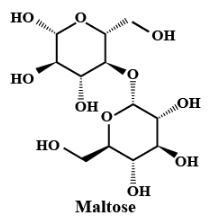
An organic compound answers Molisch's test as well as Benedict's test. But it does not answer Scliwanoff's test. Most probably, it is
  • A
    Sucrose
  • B
    Protein
  • C
    Fructose
  • Maltose

Answer

Correct option: D.
Maltose
d
An organic compound answers Molisch's test as well as Benedict's test. But it does not answer Scliwanoff's test. Most probably, it is Maltose. It is a reducing sugar. Molisch's test is used to detect all kinds of carbohydrates. The Benedict's test identifies reducing sugars (monosaccharides and some disaccharides), which have free ketone or aldehyde functional groups. Scliwanoff's test is simple test that is used for the detection/presence of fructose or keto group in a sugar solution.

Need a full question paper?

Generate a complete, print-ready paper with questions like this in minutes — across 16+ boards, with answer keys.

Start Generating Free

Similar questions

Reaction $CH _3 Br + OH ^{-} \longrightarrow CH _3 OH + Br ^{-}$; proceeds through $S _{ N } 2$ mechanism. Its rate depends on the concentration of the :
Action of hydrogen chloride on $\begin{array}{*{20}{c}}
  {C{H_3} - C = C{H_2}} \\ 
  |\,\,\, \\ 
  \,\,\,{C{H_3}} 
\end{array}$ and on $CH \equiv CH$ will predominantly give the compounds, respectively :-
$\begin{matrix}
   \,\,\,\,\,O\,\,\,\,\,\,\,\,\,\,\,\,\,\,\,\,\,\,\,\,\,\,\,\,C{{H}_{3}}  \\
   ||\,\,\,\,\,\,\,\,\,\,\,\,\,\,\,\,\,\,\,\,\,\,\,\,\,\,\,\,|\,  \\
   C{{H}_{3}}-C-C{{H}_{2}}-C-CHO  \\
   \,\,\,\,\,\,\,\,\,\,\,\,\,\,\,\,\,\,\,\,\,\,\,\,\,\,\,\,\,\,\,|  \\
   \,\,\,\,\,\,\,\,\,\,\,\,\,\,\,\,\,\,\,\,\,\,\,\,\,\,\,\,\,\,\,\,\,\,\,\,C{{H}_{3}}  \\
\end{matrix}\xrightarrow{KOH,{{H}_{2}}O}(A);$ Product $A$ is
What is the spin-only magnetic moment value $(BM)$ of a divalent metal ion with atomic number $25,$ in it's aqueous solution ?
$p$-Amino- $N, N$-dimethylaniline is added to a strongly acidic solution of ${X}$. The resulting solution is treated with a few drops of aqueous solution of ${Y}$ to yield blue coloration due to the formation of methylene blue. Treatment of the aqueous solution of ${Y}$ with the reagent potassium hexacyanoferrate$(II)$ leads to the formation of an intense blue precipitate. The precipitate dissolves on excess addition of the reagent. Similarly, treatment of the solution of ${Y}$ with the solution of potassium hexacyanoferrate$(III)$ leads to a brown coloration due to the formation of ${Z}$.

$1.$ The compound ${X}$ is

$(A)$ $\mathrm{NaNO}_3$ $(B)$ $\mathrm{NaCl}$ $(C)$ $\mathrm{Na}_2 \mathrm{SO}_4$ $(D)$ $\mathrm{Na}_2 \mathrm{~S}$

$2.$ The compound ${Y}$ is

$(A)$ $\mathrm{MgCl}_2$ $(B)$ $\mathrm{FeCl}_2$ $(C)$ $\mathrm{FeCl}_3$ $(D)$ $\mathrm{ZnCl}_2$

$3.$ The compound ${Z}$ is

$(A)$ $\left.\mathrm{Mg}_2 \mid \mathrm{Fe}(\mathrm{CN})_6\right]$ $(B)$ $\operatorname{Fe}\left[\mathrm{Fe}(\mathrm{CN})_6\right]$

$(C)$ $\mathrm{Fe}_4\left[\mathrm{Fe}(\mathrm{CN})_6\right]_3$ $(D)$ $\mathrm{K}_2 \mathrm{Zn}_3\left[\mathrm{Fe}(\mathrm{CN})_6\right]_2$

Give the answer question $1,2$ and $3.$

Which of the following reaction does not give aldehyde as a product
The $pK_a$ values for the three ionizable groups $X , Y$ and $Z$ of glutamic  acid are $4.3, 9.7$ and $2.2$ respectively

$\begin{matrix}
   \underset{X}{\mathop{H}}{{O}_{2}}C-C{{H}_{2}}-CH-C{{O}_{2}}\underset{Z}{\mathop{H}}\,  \\
   \,\,\,\,\,\,\,\,\,\,\,|  \\
   \,\,\,\,\,\,\,\,\,\,\,\,\,+N{{H}_{3}}  \\
\end{matrix}$

The isoelectric point for the amino acid is
A complex containing $K^+, Pt(IV)$ and $Cl^-$ is $100\%$ ionised giving $i = 3$. Thus,  possible complex is 
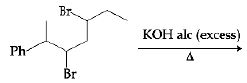
The major product of the following reaction is
How much water is needed to dilute $10 \, ml$ of $10 \, N$ hydrochloric acid to make it exactly decinormal ($0.1\,N$) .......... $ml$