Question
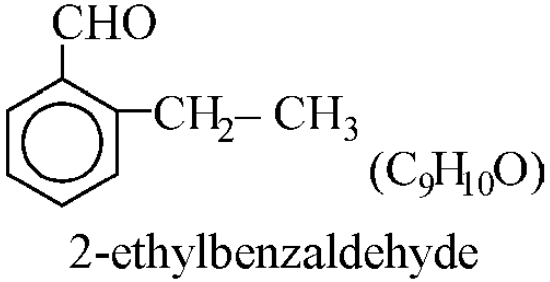
An organic compound with the molecular formula $C _9 H _{10} O$ forms 2,4-DNP derivative, reduces Tollens' reagent and undergoes Cannizzaro reaction. On vigorous oxidation it gives 1,2-benzene dicarboxylic acid. Identify the compound.

Answer

This organic compound forms 2,4-DNP derivative. So this will be carbonyl compound (Aldehyde or Ketone).
But it reduces Tollens' reagent so this is Aldehyde and giving Cannizzaro reaction, hence $\alpha- H$ are absent in it. Oxidation of it forms 1,2-benzene dicarboxylic acid.
Image
Oxidation product proves that it have one benzene ring, one - COOH group forms from oxidation of - CHO group and another - COOH group by the oxidation of Alkyl group. So according to molecular formula the structural formula of this will be :
Image

Need a full question paper?

Generate a complete, print-ready paper with questions like this in minutes — across 16+ boards, with answer keys.

Start Generating Free

Similar questions

Write the $\text{IUPAC}$ names of the following coordination compounds:
  1. $\ce{[Cr(NH_3)_3cl_3]}$
  2. $\ce{K3[Fe(CN)_6]}$
  3. $\ce{[CoBr_2(em)_2]}^+, ($en $=$ ethylenediamine$)$
  1. What is the basis of formation of the spectro $-$ chemical series?
  2. Draw the structures of geometrical isomers of the following coordination
  3. complexes:$\ce{[Co(NH_3)_3Cl_3]}$ and $\ce{[CoCl_2(en)_2]^+}.$
  4. $($ en $=$ ethylenediamine and atomic number of $Co$ is $27).$
How long will it take an electric current of $0.15 A$ to deposit all the copper from $500 \ ml$ of $0.15 \ M$ copper sulphate solution?
How much electricity will be required to obtain 1.5 gram on copper in 3 hours in an electrolytic cell of aqueous solution of copper sulphate? (Atomic mass of Cu = 63.5 )
The following results have been obtained during the kinetic studies of the reaction.
$2A + BC \rightarrow D$
Experiment $[A]/mol L^{-1}$ $[B]/mol L^{-1}$ Initial rate of formation of $D/mol L^{-1} \min^{-1}$
$I$ $0.1$ $0.1$ $6.0 x 10^{-3}$
$II$ $0.3$ $0.2$ $7.2 x 10^{-2}$
$III$ $0.3$ $0.4$ $2.88 \times 10^{-1}$
$IV$ $0.4$ $0.1$ $2.40 x 10^{-2}$

Determine the rate law and the rate constant for the reaction.
Explain types of Electrodes with examples
Give chemical tests to distinguish between the following pairs of compounds:
  1. Propanal and propanone.
  2. Methyl acetate and ethyl acetate.
  3. Benzaldehyde and benzoic acid.
Calculate the mass percentage of benzene $(C_6H_6)$ and carbon tetrachloride $(CCl_4)$ if $22 g$ of benzene is dissolved in $122 g$ of carbon tetrachloride.
Estimate the minimum potential difference needed to reduce $Al_2O_3 at 500^\circ C$. The free energy change for the decomposition reaction,
$\frac{2}{3}\text{Al}_2\text{O}_3\frac{4}{3}\text{Al + O}_2\text{ is }960\text{kJ (F = 96500C mol}-1)$
A first order gas reaction $\ce{A_2B_2(g) \rightarrow 2A(g) + 2B(g)}$ at the temperature $400^\circ C$ has the rate constant $K = 2.0 \times 10^{-4}s^{-1}$ . What percentage of $A_2B_2$ is decomposed on heating for $900$ seconds.