Question
An organic compound with the molecular formula $\ce{C_9H_{10}O}$ forms $2,4-\ce{DNP}$ derivative, reduces Tollens’ reagent and undergoes Cannizzaro reaction. On vigorous oxidation, it gives $1, 2-$ benzenedicarboxylic acid. Identify the compound.
Answer

It is given that the compound $($with molecular formula $\ce{C_9H_{10}O)}$ forms $2, 4-\ce{DNP}$ derivative and reduces Tollen's reagent.
Therefore, the given compound must be an aldehyde.
Again, the compound undergoes cannizzaro reaction and on oxidation gives $1, 2- $ benzenedicarboxylic acid.
Therefore, the $-\ce{CHO}$ group is directly attached to a benzene ring and this benzaldehyde is or tho $-$ substituted.
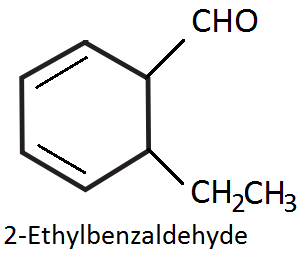
Hence, the compound is $2-$ ethylbenzaldehyde.

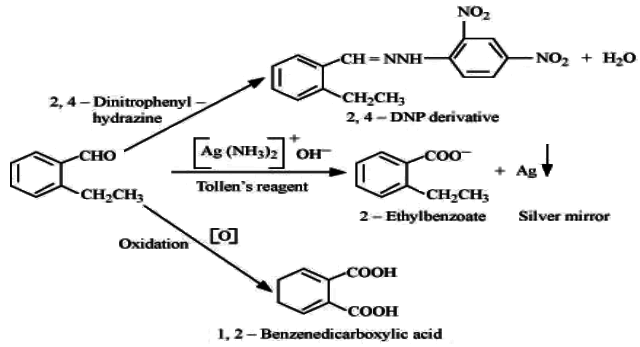
The given reactions can be explained by the following equations.


Need a full question paper?

Generate a complete, print-ready paper with questions like this in minutes — across 16+ boards, with answer keys.

Start Generating Free

Similar questions

18 g of glucose ($ C_{6}H_{12}O_{6} $) was added to 1 kg of water at 1.013 bar atmospheric pressure in a vessel. At which temperature will water boil? $ K_{b} $ for $ H_{2}O $ is 0.52 K kg $ mol^{-1} $.
What is the importance of amino acids to us?
What is meant by inversion of sugar?
Write common name and IUPAC name of following alcohol compound.
Image
Chloroform is stored in closed dark coloured bottles completely filled so that air is kept out. Describe reason with equation.
If the solubility product of CuS is 6 x 10-16, calculate the maximum molarity of CuS in aqueous solution.
Note: In the following questions a statement of assertion followed by a statement of reason is given. Choose the correct answer out of the following choices.
Assertion: $Λ_m$ for weak electrolytes shows a sharp increase when the electrolytic solution is diluted.
Reason: For weak electrolytes degree of dissociation increases with dilution of solution.
What happens when benzene diazonium chloride reacts with potassium iodide ? Write only equation of the reaction.
Anhydrous $CuSO _4$ is white but hydrated $CuSO _4$ is blue while both contain $Cu ^{2+}$ ions. Why?
Match the reactions given in Column $I$ with the suitable reagents given in Column $II.$ 
 
Column $I ($Reactions$)$
 
Column $II ($Reagents$)$
$(i)$
Benzophenone $\rightarrow$ Diphenylmethane
$(a)$
$\ce{LiAlH_4}$
$(ii)$
enzaldehyde $\rightarrow 1-$Phenylethanol
$(b)$
$\ce{DIBAL-H}$
$(iii)$
Cyclohexanone $\rightarrow$ Cyclohexanol
$(c)$
$\ce{Zn(Hg)/Conc. HCl}$
$(iv)$
Phenyl benzoate $\rightarrow$ Benzaldehyde
$(d)$
$\ce{CH_3MgBr}$