MCQ
An oxidising agent is a substance, which
  • A
    Accept proton
  • Accept electron
  • C
    Accept neutron
  • D
    Donate electron

Answer

Correct option: B.
Accept electron
b
Oxidising agent oxidises another substance and reduces it self i.e. accepts electron.

Need a full question paper?

Generate a complete, print-ready paper with questions like this in minutes — across 16+ boards, with answer keys.

Start Generating Free

Similar questions

What will be the molality of the solution containing $18.25g$ of $\text{HCl }$ gas in $500g$ of water?
Which one is least ionic in the following compounds
Based on $VSEPR$ model, match the xenon compounds given in $List-I$ with the corresponding. geometries and the number of lone pairs on xenon given in $List-II$ and choose the correct option.
$List-I$ $List-II$
($P$) $XeF _2$ ($1$) Trigonal bipyramidal and two lone pair of electrons
($Q$) $XeF _4$ ($2$) Tetrahedral and one lone pair of electrons
($R$) $XeO _3$ ($3$) Octahedral and two lone pair of electrons
($S$) $XeO _3 F _2$ ($4$) Trigonal bipyramidal and no lone pair of electrons
  ($5$) Trigonal bipyramidal and three lone pair of electrons
$2\,g$ of oxygen contains number of atoms equal to that in
For the reaction $PC{l_5}_{(g)}$ $\rightleftharpoons$ $PC{l_3}_{(g)} + C{l_2}_{(g)}$, the forward reaction at constant temperature is favoured by
In the reaction with $HCl$, an alkene reacts in accordance with the Markovnikov's rule, to give a product $1-$ chloro $-1-$ methylcyclohexane. The possible alkene is
What is the name of the alkene $\mathrm{H}_2 \mathrm{C}=\mathrm{CH}-\mathrm{CH}=\mathrm{CH}_2\ ?$
Match the transformations in column $I$ with appropriate options in column $II$
column $I$ column $II$
$(A)$ $CO _2( s ) \rightarrow CO _2( g )$ $(p)$ phase transition
$(B)$ $CaCO _3( s ) \rightarrow CaO$ (s) $+ CO _2( g )$ $(q)$ allotropic change
$(C)$ $2 H \bullet \rightarrow H _2( g )$ $(r)$ $\Delta H$ is positive
$(D)$ $P_{\text {(white, solid) }} \rightarrow P_{\text {(red, solid) }}$ $(s)$ $\Delta S$ is positive
  $(t)$ $\Delta S$ is negative
In allene $\left( C _3 H _4\right)$, the type$(s)$ of hybridisation of the carbon atoms is (are):
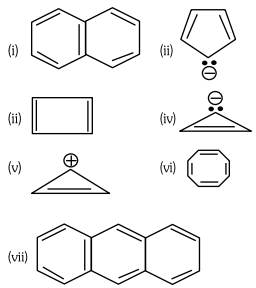
Consider the following compounds/species: 

The number of compounds/species which obey Huckel's rule is $..........$