MCQ
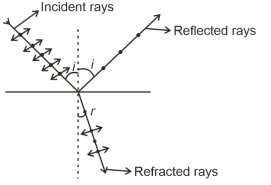
An unpolarised light beam strikes a glass surface at Brewster's angle. Then
  • A
    The refracted light will be completely polarised.
  • B
    Both the reflected and refracted light will be completely polarised.
  • The reflected light will be completely polarised but the refracted light will be partially polarised.
  • D
    The reflected light will be partially polarised.
Answer

Correct option: C.
The reflected light will be completely polarised but the refracted light will be partially polarised.
c
According to Brewster's law, reflected rays are completely polarized and refracted rays are partially polarized.

Need a full question paper?

Generate a complete, print-ready paper with questions like this in minutes — across 16+ boards, with answer keys.

Start Generating Free

Similar questions

The ratio of electric fields on the axis and at equator of an electric dipole will be
In the Bohr model of the hydrogen atom, let $R, v$ and $E$ represent the radius of the orbit, the speed of electron and the total energy of the electron respectively. Which of the following quantity is proportional to the quantum number $n$
Which of the following is vector quantity
Which among the following is an application of microwaves?
How will the force between the two poles change if the two poles are connected by an iron rod keeping the distance between two magnetic poles constant ?
Diffraction of light can be explained by the following:
Figure below shows a portion of an electric circuit with the currents in amperes and their directions. The magnitude and direction of the current in the portion $P Q$ is
An electron moving with a velocity ${\vec V_1} = 2\,\hat i\,\, m/s$ at a point in a magnetic field experiences a force ${\vec F_1} =  - 2\hat j\,N$ .  If the electron is moving with a velocity ${\vec V_2} = 2\,\hat j \,\,m/s$ at the same point, it experiences a force ${\vec F_2} =  + 2\,\hat i\,N$ .  The force the electron would experience if it were moving with a velocity ${\vec V_3} = 2\hat k$  $m/s$ at the same point is
For a substance the average life for $\alpha$-emission is $1620$ years and for $\beta$ emission is $405$ years. After how much time the $1/4$ of the material remains after $\alpha$ and $\beta$ emission .......$years$
Young's double slit experiment is performed with monochromatic light. A thin film is introduced in front of one of the slits