Question
An unsymmetrical double convex thin lens forms the image of a point object on its axis. Will the position of the image change if the lens is reversed?
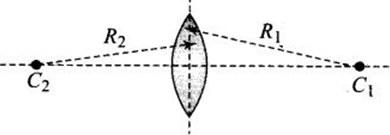 By lens maker's formula, $\frac{1}{\text{f}}=(\mu-1)\Big(\frac{1}{\text{R}_1}+\frac{1}{\text{R}_2}\Big)$ For this position R1 is positive and R2 is negative. Hence focal lenght at this position $\frac{1}{\text{f}_1}=(\mu-1)\Big(\frac{1}{(+\text{R}_1)}-\frac{1}{(-\text{R}_2)}\Big)=(\mu-1)\Big(\frac{1}{\text{R}_1}+\frac{1}{\text{R}_2}\Big)$
 Now the lens is reversed,
At this position, R2 is positive and R1 is negative. Hence focal length at this position is $\frac{1}{\text{f}_2}=(\mu-1)\Big(\frac{1}{(+\text{R}_2)}-\frac{1}{(-\text{R}_1)}\Big)=(\mu-1)\Big(\frac{1}{\text{R}_1}+\frac{1}{\text{R}_2}\Big)$ We can observe the focal length of the lens does not change in both positions, hence the image position remains unchanged.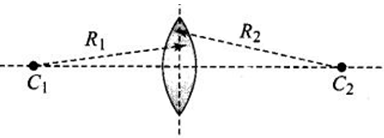
Generate a complete, print-ready paper with questions like this in minutes — across 16+ boards, with answer keys.