MCQ
An X-ray machine has an accelerating potential difference of 25,000 volts. By calculation the shortest wavelength will be obtained as (h = $6.63 \times 10^{-34} \mathrm{~J}-\mathrm{sec}$; e =$ 1.6.\times 10^{-19} $ coulomb)
  • A
    0.25 Å
  • 0.50 Å
  • C
    1.00 Å
  • D
    2.50 Å

Answer

Correct option: B.
0.50 Å
(b) 0.50 Å

Need a full question paper?

Generate a complete, print-ready paper with questions like this in minutes — across 16+ boards, with answer keys.

Start Generating Free

Similar questions

The frequency of light ray having the wavelength $3000 \mathring A$ is
A ray of ligh is incident at an angle of incidence $60^{\circ}$ on the glass slab of refractive index $\sqrt{3}$. After refraction, the light ray emerges out from other parallel faces and lateral shift between incident ray and emergent ray is $4 \sqrt{3} \,cm$. The thickness of the glass slab is. . .  .. . $cm$.
What is the magnetic field at a distance $R$ from a coil of radius $r$ carrying current $I$ ?
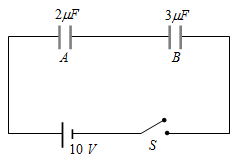
Two capacitors A and B are connected in series with a battery as shown in the figure. When the switch S is closed and the two capacitors get charged fully, then


A rod of length $l$ rotates with a uniform angular velocity $\omega $ about an axis passing through its middle point but normal to its length in a uniform magnetic field of induction $B$ with its direction parallel to the axis of rotation. The induced $emf$ between the two ends of the rod is
A parallel beam of monochromatic light is incident at one surface of a equilateral prism. Angle of incidence is 55° and angle of emergence is 46°. The angle of minimum deviation will be
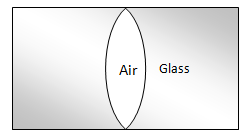
In the figure, an air lens of radii of curvature 10 cm ($\mathrm{R}_1=\mathrm{R}_2=10 \mathrm{~cm}$) is cut in a cylinder of glass (μ = 1.5). The focal length and the nature of the lens is
Two sine waves travel in the same direction in a medium. The amplitude of each wave is $A$ and the phase difference between the two waves is $120^\circ$. The resultant amplitude will be:
 
The chromatic Aberration in lenses becomes due to
The magnitude of acceleration of the electron in the $n$th orbit of hydrogen atom is $a_{ H }$ and that of singly ionised helium atom is $a_{ He }$. The ratio of $a_{ H }: a_{ He }$ is