Question
Analyse India's changing relationship with post-Communist Russia.

Answer

India has maintained good relations with all the respective socialist countries but most cordial relations are still there between Russia and India.
  1. Embedded in the history, trust and common interests.
  2. Both share vision of multipolar world, collective security, greater regionalism, negotiated settlements of international conflicts, an independent foreign policy for all countries etc.
  3. Democratisation and empowerment of bodies like the U.N.
  4. More than 80 bilateral agreements have been signed between India and Russia as part of the Indo-Russian strategic Agreement of 2001.
  5. India benefits on issues like Kashmir issue, energy supplies, sharing information, access to central Asia balancing the relation with China.
  6. India is second largest arms market for Russia.
  7. Russia is important to India and has repeatedly come to the assistance of India during its oil crisis.
  8. Russia is important for Indian nuclear energy plans and it assisted India's space industry also.

Need a full question paper?

Generate a complete, print-ready paper with questions like this in minutes — across 16+ boards, with answer keys.
Start Generating Free

Similar questions

Explain any two strategies to overcome hegemony.
Do movements and protests in a country strengthen democracy? Justify your answer with examples.
Evaluate any three major factors responsible for making the European Union a political force from being an economic force.
Explain any three consequences of partition of British India in 1947.
“The conduct of foreign affairs is an outcome of a two-way interaction between domestic compulsions and prevailing international climate”. Take one example from India’s external relations in the 1960s to substantiate your answer.
What is meant by ‘Shock Therapy’? Assess its consequences on the post-communist regimes.
What was the major thrust of the First Five Year Plan? In which ways did the Second Plan differ from the first one?
How did the Soviet Union suddenly disintegrate? Explain any six reasons.
Read the passage given below carefully and answer the following questions:
The ‘Cuban Missile Crisis’ was a high point of what came to be known as the Cold War. The Cold War referred to the competitions, the tensions and a series of confrontations between the United States of America and the Soviet Union, backed by their respective allies. Fortunately, however, it never escalated into a ‘hot war’.
  1. Explain the meaning of ‘hot war’.
  2. Why was the ‘Cuban Missile Crisis’ considered as the high point of the Cold War?
  3. ‘‘Ideological conflict was also a cause of the Cold War.’’ How far do you agree with the statement?
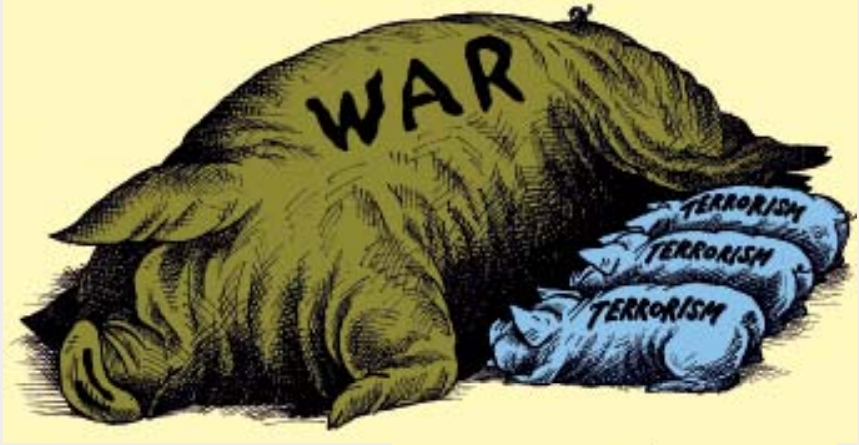
Read the cartoon below and write a short note in favour or against the connection between war and terrorism depicted in this cartoon.