Question
____ And _____ led to understanding of atomic structures:
  1. Fresnel diffraction.
  2. Cathode rays.
  3. X-rays.
  4. Electrons.

Answer

  1. (iii) And (iv).

Need a full question paper?

Generate a complete, print-ready paper with questions like this in minutes — across 16+ boards, with answer keys.
Start Generating Free

Similar questions

γ-rays radiation can be used to create electron-positron pair. In this process of pair production, γ-rays energy cannot be less than(a) 5.0 MeV(b) 4.02 MeV(c) 15.0 MeV(d) 1.02 MeV
       
An LCR series circuit with $100\Omega$ resistance is connected to an ac source of 200V and of frequency of $\frac{300 \text{rad}}{\text{s}}$. When only the capacitance is removed, the current lags behind the voltage by 600. When only the inductance is removed, the current leads the voltage by 60° the current through the circuit is:
Which of the following is true (a) Common base transistor is commonly used because current gain is maximum(b) Common emitter is commonly used because current gain is maximum(c) Common collector is commonly used because current gain is maximum (d) Common emitter is the least used transistor


The wavefronts of a light wave travelling in vacuum are given by $x + y + z = c.$ The angle made by the direction of propagation of light with the $X-$axis is:
A long horizontal metallic rod with length along the east-west direction is falling under gravity. The potential difference between its two ends will            (a) Be zero(b) Be constant(c) Increase with time(d) Decrease with time
       
What type of surface is the surface of a conductor?
Two identical thin rings each of radius $R$ meters are coaxially placed at a distance $R$ meters apart. If $Q_1$ coulomb and $Q_2$ coulomb are respectively the charges uniformly spread on the two rings, the work done in moving a charge qfrom the centre of one ring to that of other is
Magnetic lines of force can pass through:
Energy of an electron in an excited hydrogen atom is $– 3.4 eV.$ Its angular momentum will be: $h = 6.626 \times 10^{-34} \mathrm{~J}-\mathrm{s}$ 
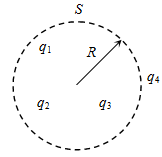
$q_1, q_2, q_3$ and $q_4$ are point charges located at points as shown in the figure and $S$ is a spherical Gaussian surface of radius $R$. Which of the following is true according to the Gauss’s law