MCQ
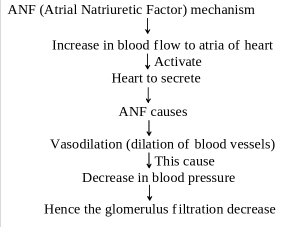
$ANF$ (Anti Natriuretic Factor) is released by
- ALung
- BKidney
- ✓Heart
- DAll of the above
Generate a complete, print-ready paper with questions like this in minutes — across 16+ boards, with answer keys.
|
Column $I$ (Epithelial tissue) |
Column $II$ (Location) |
| $A.$ Cuboidal | $I.$ Epidermis of skin |
| $B.$ Ciliated | $II.$ Inner lining of blood vessels |
| $C.$ Columnar | $III.$ Inner surface of gall bladder |
| $D.$ Squamous | $IV.$ Inner lining of fallopian tube |
| $E.$ Keratinized squamous | $V.$ Lining of pancreatic duct |
Choose the correct option for $A , B$ and $C$
$(a)$ In roots, xylem and phloem in a vascular bundle are arranged in an alternate manner along the different radii.
$(b)$ Conjoint closed vascular bundles do not possess cambium
$(c)$ In open vascular bundles, cambium is present in between xylem and phloem
$(d)$ The vascular bundles of dicotyledonous stem possess endarch protoxylem
$(e)$ In monocotyledonous root, usually there are more than six xylem bundles present.
Choose the correct answer from the options given below:
$(I)$ Malpighian corpuscles, $PCT$ and $DCT$ the nephron are situated in medulla of the kidney
$(II)$ The loop of henle dips into medulla.
$(III)$ In juxta medullary nephrons, the loop of henle is too short and extends very little into the medulla.
$(IV)$ Vasa recta is absent or highly reduced in cortical nephrons.