Question
Angina pectoris.

Answer

  1. Angina pectoris is the pain in the chest. It results from a reduction in blood supply to cardiac muscle due to narrowed and hardened coronary arteries.
  2. Atherosclerosis and arteriosclerosis can cause this problem. Basically, the coronary arteries are affected during angina pectoris.
  3. It causes heaviness and severe pain in the chest. The pain can also be felt at the neck, lower jaw, left arm and left shoulder.
  4. Angina pectoris often occurs during exertion, when the heart demands more oxygen and narrowed blood vessels cannot supply. It disappears with rest.

Need a full question paper?

Generate a complete, print-ready paper with questions like this in minutes — across 16+ boards, with answer keys.
Start Generating Free

Similar questions

What are the adaptations in animals living under crushing pressure at great depths of ocean?
Answer the following questions:
Describe the stages of oogenesis in human females.
A few statements are given below followed by a set of terms in a box. Pick the correct term and write it against the appropriate statement,
  1. Mating of closely related individuals within the same breed.
  2. Mating of animals of same breed but having no common ancestors on either side for 4-6 generations.
  3. Mating of animals of two different species.
  4. Breeding of animals belonging to different breeds.
  1. Cross breeding.
  2. Inter-specific hybridization.
  3. Out breeding.
  4. Out crossing.
  5. Inbreeding.
Explain sigmoid growth curve with the help of diagram.
What are the main endocrine glands in human body?
Vasa efferentia and Vasa deferentia.
  1. How did Hardy-Weinberg explain that allelic frequencies in a population are stable and are constant from generation to generation?
  2. Why does genetic equilibrium get disturbed in a population? Give reasons.
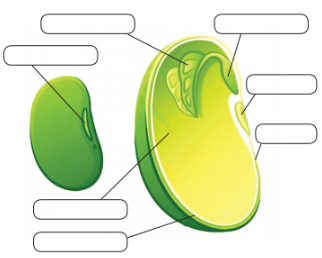
Label the parts of seed

Image

The following table shows certain diseases, their causative organisms and symptoms. Fill the gaps.
  Name of the Disease Causative organism Symptoms
i. Ascariasis Ascaris ________
ii. ________ Trichophyton Appearance of dry, scaly lesions on various parts of the body.
iii. Typhoid ________ High fever, weakness, headache, stomach pain, constipation.
iv. Pneumonia Streptococcus pneumoniae ________
v. ________ Rhino viruses Nasal congestion and discharge, sorethroat, cough, headache.
vi. Filariasis ________ Inflammation in lower limbs.
Why are obese persons prone to hypertension?